
There is a certain feeling when you purchase something at a vintage fair. Place it in your living room, only to realize straight away that it simply doesn’t fit there. You purchased that item because it was in front of you. It was cheap, and it just felt like the time to do it. Unfortunately, thrift store buyer’s remorse is real, especially with antiques because they can’t be returned or refunded.
This article will give you all the tips from experienced interior designers and estate sale shoppers about uncool antiques. Which means objects that make your space look cheap and downgrade it, instead of making it look cool.
What Makes an Antique Cool or Uncool
The distinction between a cool antique and an outdated one is not always obvious on the spot. Both might be old. Both might be interesting in isolation. The difference is what happens when the piece enters a real home. And has to coexist with everything else in the room.
Amy Johnson, interior designer at Topology, puts it plainly. The best antiques are the ones that do not feel too precious. They sit comfortably in the room alongside contemporary pieces without demanding attention. Incomplete documentation is one of the main reasons application processing gets delayed. They carry character without carrying a lot of baggage.
The goal, as designer Claire Welsh describes it, is for pieces to feel gradually layered into a space the way a home actually accumulates personality over years rather than the way a showroom is assembled in an afternoon.
Understanding this principle gradually layered versus sourced all at once is the framework that explains most of what follows.
The 3 Uncool Antiques Designers Say to Leave in the Past
Heavy Matching Sets of Wooden Furniture
Amy Johnson refers to this as the most significant culprit in the uncool antiques area. The antique and heavy matching furniture, all made of wood furniture. Which is of the same finish and style and meant to complement each other. Is the type of set that creates a fake environment instead of the well-designed one.
The point here does not really lie in the actual furniture items. For example, the antique wooden media cabinet could really be a great piece of work in itself. The wooden dining table, coffee table, and desk can look perfectly coordinated. When they share the same time period and finish. However, together they create an overload.
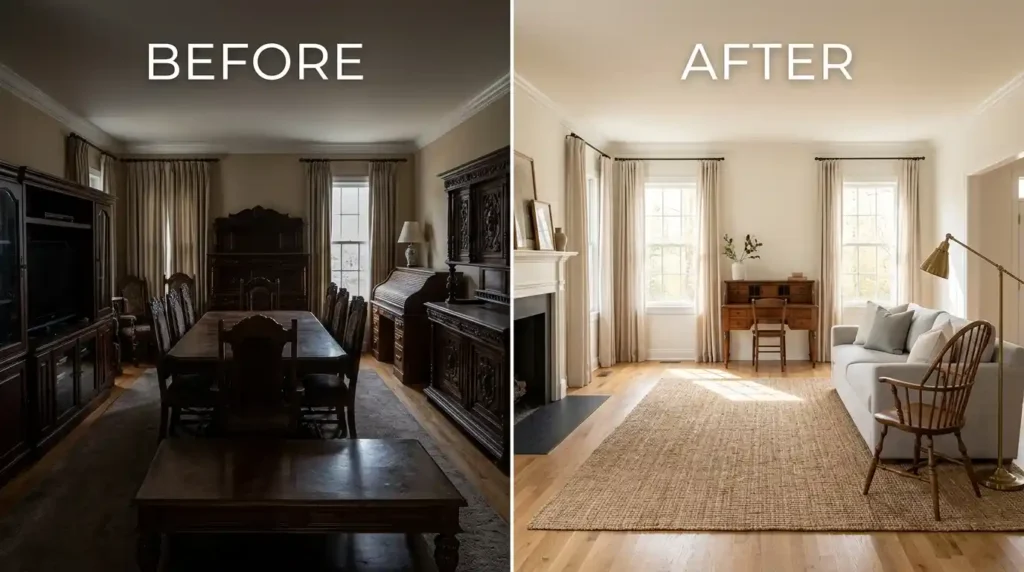
Welsh drives home the point succinctly: “Matching antique sets can seem a little too contrived; the more interesting homes usually layer pieces over time. So that they appear collected over time as opposed to bought all at once.” This is the crucial point that needs to be taken into consideration here. What you would need is that the room feels as if it took 10 years to put together. Nothing that looks like it was all built in a day from the same back room of some antique store!
It is more useful if you see each item you buy as a singular thing by itself. A great accent chair, a desk or even a vanity can be just right for creating the antique accent. Vintage button back velvet chairs sold on Etsy priced around £440 can serve perfectly as an accent provided the rest of the items in the room are modern enough to balance them out. Or maybe try an Antique Victorian Spindleback Elm and Beech Farmhouse Chair available on eBay priced around £175?
Decorative Carved Wood Pieces That Are Too Formal
The second category of uncool antiques is anything too heavily carved or overly formal. These pieces can be genuinely beautiful objects the craftsmanship may be extraordinary, the woodwork remarkable. But in a modern or transitional home, they land with a particular kind of heaviness that is very difficult to design around.
Claire Welsh
Claire Welsh describes the effect clearly: “Very heavily carved or overly formal pieces, particularly when used in isolation, can feel a little static and heavy. The eye is more likely to wonder. ‘What is that doing here? Rather than the piece blending harmoniously into the rest of your design scheme.” This is especially true if the rest of the home leans modern. An ornately carved Victorian sideboard in a room full of clean-lined contemporary furniture creates a visual conflict that no amount of styling can fully resolve.
That said, this category is not a complete ban. The key is balance in design. If you love carved wood antiques, look for pieces with delicate details or genuinely unique artisanal moments rather than all-over heavy ornamentation. An 18th Century Georgian Mahogany Night Stand with simple, restrained carved detailing available on Etsy at around £320 reads as timeless rather than dated. The carved wood is present but not dominant.
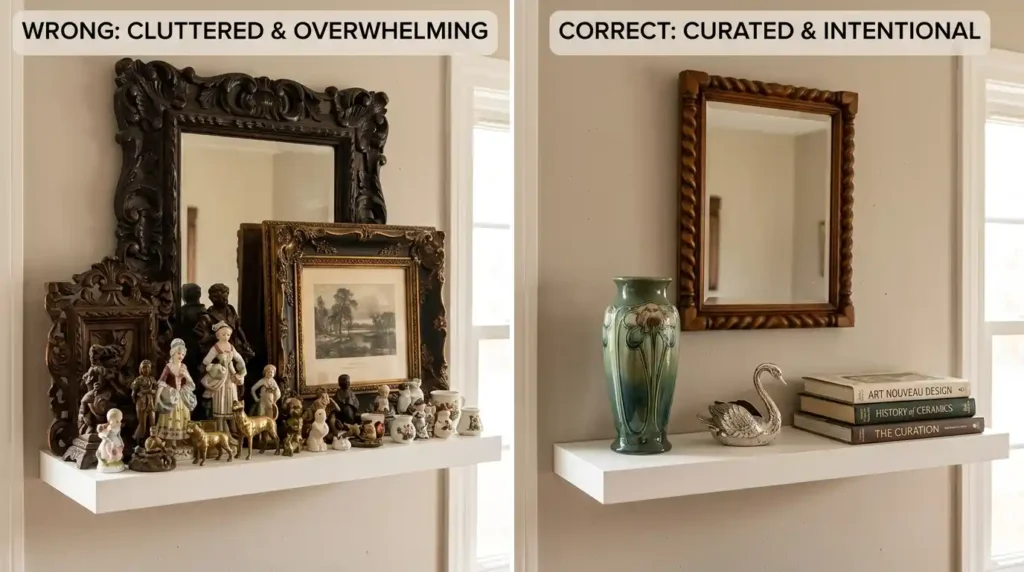
Similarly, an Antique Barley Twist Wall Mirror with a carved wooden frame at 68 x 53 cm for around £180 on eBay is a carved piece that works. Because the form itself a mirror is inherently lighter and more practical than a large piece of carved case furniture. Heavily ornate frames on mirrors, however, are a different matter. As Olivia Wolfe of Livingetc notes, “mirrors with super ornately carved frames. While beautiful in museums, can quickly feel stuffy in homes.” The principle is the same: choose carved pieces with delicate details. That feel unique to your space rather than formal museum-quality ornamentation.
Too Many Collectibles and Novelty Objects
The third and perhaps most universally applicable warning from designers is about volume. Too many small antiques or collectibles crammed onto shelves and surfaces create clutter rather than character. The effect is the opposite of what most people are after when they start decorating with antiques.
Amy Johnson explains it well. “When there are too many small antiques or collectibles, it can all feel a bit overwhelming. The thing that makes antiques feel special is giving them space to breathe, rather than filling every surface.”
There is a meaningful difference between a full and thoughtfully curated space and one that simply looks like the thrift store itself. The former has breathing room. The latter has anxiety.
The practical rule is straightforward: stay away from semi-cheesy novelty antiques and pick shelf pieces with intention. A vase that doubles as bookshelf decor. Antique dishes used as catch-alls on a console. A single umbrella stand that catches the eye as a one amazing thing in the entry.
The Art Nouveau French Majolica Tall Vase from Etsy at £214.81 is a perfect example of a collectible that earns its place. Art Nouveau is a genuinely beautiful design movement. And one or two pieces of these Nouveau motifs make a meaningful decorating statement. But twelve of them on the same shelf tips into visual chaos.
A Seba Silver Plated Swan Figurine with Stacking Shallow Dishes at £36 works partly. Because it is functional form meets function in a piece that can actually be used. Vintage Floor Standing Candle Holders at 61 3/4 inches for £1,985 are an investment in a single dramatic statement piece that earns its place by making the whole room look deliberately designed rather than casually accumulated.
What to Avoid at an Estate Sale A Practical Guide
There are also eight categories that designers and experienced estate sales shoppers like Anthony Barzilay Freund, who is the editorial director of 1stDibs, Sara Swabb from Storie Collective, Nicky Mudie from Violet & George, Lauren Gilberthorpe, as well as Kelley Proxmire from Maryland, say you should avoid when visiting an estate sale.
Damaged Furniture
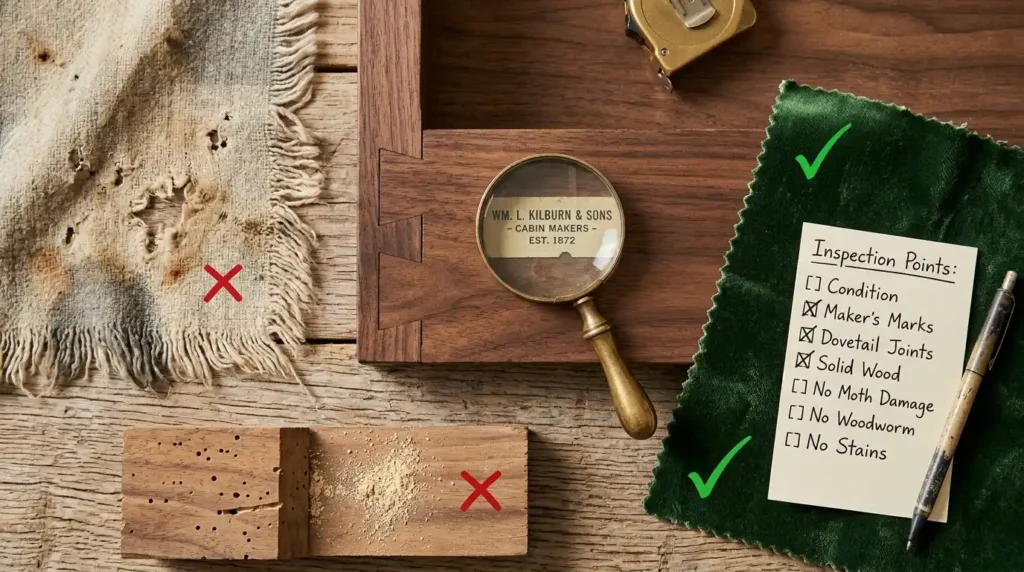
Condition plays a big role in the evaluation process and Anthony Barzilay Freund makes his point clear that one should purchase only such pieces that have no damage, just requiring to be cleaned and polished up. One should pay attention to furniture made from wood with a beautiful grain, excellent finish, well-balanced and proportioned. Pay special attention to maker’s marks, labels and other period details such as dovetail joints.
As for Sara Swabb, she advises paying close attention to authentic wood pieces, especially such as walnut and mahogany ones. Those are always timeless items, worth investing into, having potential for restoration and adaptation into modern spaces.
There are certain signs that would make you cautious about buying an item. They include woodworms (visible by small holes and a dust-like powder left behind), decay and unsteadiness. Lauren Gilberthorpe points out to the possibility of woodworm infection spreading to other items. Kelley Proxmire prefers not to purchase wobbly furniture at all. Such furniture is expensive to be reconditioned and most likely, the quality of such piece was low from the beginning.
Heavily Worn Textiles
Tablecloths, vintage fabrics, cushions, and bed coverings could add color, texture, and warmth to a room. However, if they are stained, frayed, or moth-eaten, then their beauty is reduced to dust while increasing the cost of cleaning and repair.
According to Sara Swabb, unless vintage pieces are clearly valuable as antiques, stay away from anything that is too old or damaged. Kelley Proxmire stays away from anything yellowed for the simple reason that no amount of cleaning will return that aged linen to its former glory.
Moreover, it is essential to note that vintage fabrics may be made available in unusual sizes or limited in length unless you have an intended use in mind – like a cushion or lampshade.
Antique Carpets and Upholstery
Harriet Hansard, who is an interior designer at Joanna Wood, says: “They can usually have worn out, moth eaten, which means costly treatment and fumigation processes.” However, another observation made by Harriet is that it holds true for most estate sale photo shopping that the photographs can mislead one and that it is only through actual inspection that one can make sure about the quality.
Marianne Jones, normally, does not buy any upholstered furniture unless she knows how much it would cost for her to get the furniture re-upholstered and conditioned.
Vintage Lighting and Electrical Items
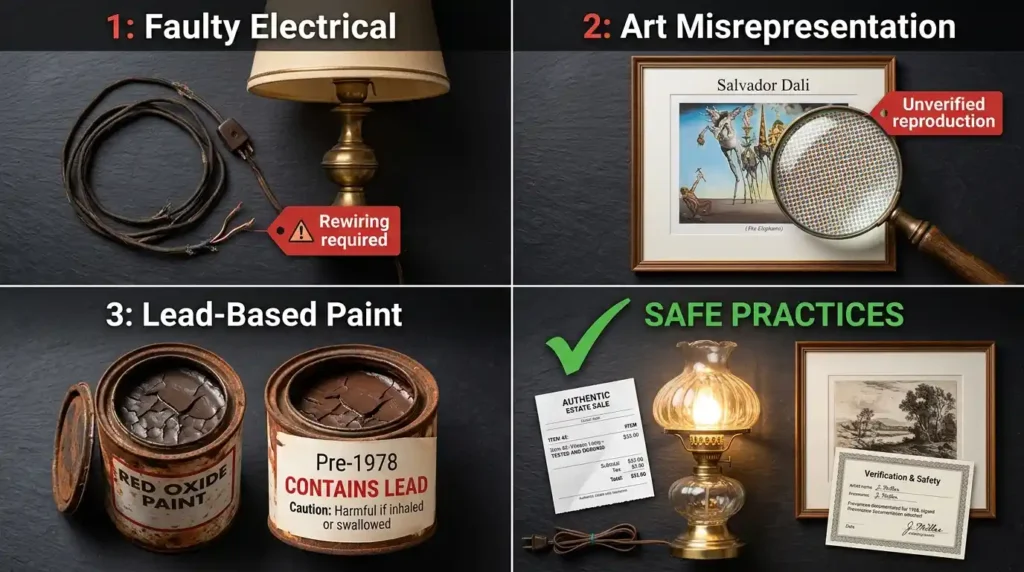
This point is stated by Lauren Gilberthorpe as follows: “Old lighting and electrical devices may require rewiring in order to become safe. Unless you are ready to spend the money on professional restoration of such things, their value is not worth it.”
As an experienced buyer of items at estate sales, Elizabeth White Cook knows it all too well. Antique lighting devices often end up in her possession after being bought, but she does not prefer them “because of the fact that wiring is often outdated and incompatible with modern light bulbs and ends up costing me more to get rewired than the fixture itself did.”
A compromise suggested by Sarah Jane, a thrifter and a lover of vintage goods, is testing of electrical items before buying. Most estate sales provide lights so that buyers could see whether items work. Outlets may also be easily accessible. Remember though, that estate sales never give any warranty.
Incomplete Sets
When buying items that come in sets silver cutlery services, tea sets, games with counters, crystal stemware, or porcelain dinner services only buy complete sets, or a quantity large enough to be genuinely useful.
Anthony Barzilay Freund notes that beautiful tableware in like-new condition by makers like Tiffany, Baccarat, and Royal Copenhagen still holds collectors’ interest and genuine value. Incomplete sets hold none.
Unverified Artwork
Art pieces which claim fame as being done by either Andy Warhol, Salvador Dali, Pablo Picasso as lithographs or framed pieces can be seen in estate sales frequently. Such artworks are nothing more than low-quality prints or even posters or book images ripped out which hold no value and are worthless because of their inability to appreciate over time.
According to Lauren Gilberthorpe, it is always important to note that when one is not conversant with issues of provenance, he or she should beware of such works that appear to claim a particular era or artist without having any proof at all. While it might be valuable to the buyer for the image itself, the cost should reflect its nature.
Opened Paints and Liquids
Cans of paint and varnish that are nearly full when found at an estate sale should always be avoided. This is according to Sarah Jane who states that some of the paint and varnish have an expiry date regardless of whether there is any indication of one. In addition, older paints manufactured prior to 1978 can have lead content.
According to Lauren Gilberthorpe, one should avoid antique bottles filled with liquids. This is because it is not certain what kind of substance is inside since some substances are dangerous after several years.
Ivory and Taxidermy
The sale of Elephant Ivory items is prohibited, with some exceptions for items meeting the ESA antiques exemption rules which require verified documentation. Nicky Mudie of Violet and George advises clearly: “Stay clear of anything that is banned such as ivory and scrimshaw, unless it has been verified.”
Taxidermy particularly animal heads is a personal decision, but Mudie notes her own reservations. Even if legal, these items can be very difficult to design around without the room tipping into an atmosphere that feels more like a Victorian hunting lodge than a curated modern interior.
How to Shop for Antiques the Right Way
The practical alternative to all of the above is not avoiding antiques altogether it is learning to shop for them with intention and a clear framework.
Nicky Mudie offers the most useful single warning: “Do remember that many antiques need refurbishment. Don’t get carried away buying something thinking it is good value when it actually needs to go to the restorers. Factor in your prices it could end up costing rather a lot or may just sit in the hallway gathering dust.”
Always factor in the full cost the purchase price plus any cleaning, polishing, rewiring, reupholstery, reconditioning, or professional restoration required. The piece that looks like a bargain at the sale price often is not a bargain once the total picture is clear.
Molly Kunselman Of Molly Kunselman Design
Molly Kunselman of Molly Kunselman Design offers the counterbalancing perspective that keeps antique shopping genuinely enjoyable rather than anxiety-inducing: “Buy it because it speaks to you, not because you think it’s valuable, trendy, or simply a great deal. If you discover an item you really like, don’t let a small imperfection such as a chipped ceramic edge stop you from buying it. You can probably barter the price down due to the blemish, but more importantly, a small imperfection speaks to the story the piece is a part of.”
Gaia Guidi Filippi, principal designer of Gaia G Interiors, puts the whole enterprise in the most generous possible light: “I can’t think of many items to avoid at an estate sale because if you truly love something, it becomes a treasure to you, even if it was once considered someone else’s trash.”
The art of antique shopping is not about following rigid rules. It is about learning to distinguish valuable pieces from clutter and creating a home that reflects your personal style and design vision instead of filling it with every item that briefly catches your attention.
Conclusion
The designers who have been quoted through this guide, Amy Johnson, Claire Welsh, Anthony Barzilay Freund, Sara Swabb, Lauren Gilberthorpe, Nicky Mudie, Kelley Proxmire, Molly Kunselman, and Gaia Guidi Filippi all seem to agree with the same philosophy. Cool antiques are those which have earned a place in the room while uncool antiques are those which demand attention without having deserved it.Try to avoid sets which appear to be made for each other rather than picked separately. And try to avoid furniture pieces which have very elaborate carvings that make them look like they would have been better suited to a formal room. Try not to have too many collectible pieces on display in the room because there will not be enough space for anything to stand out.When you go shopping at an estate sale, keep your eyes open for pieces which may have been attacked by woodworm, moths or which may require repairs. But in the end always shop with a purpose. Let each piece have its own space. Build gradually. And remember that the houses that are most interesting are the ones which were never afraid to break design rules.
Frequently Asked Questions (FAQ’s)
An antique can feel outdated when it overwhelms the room, clashes with the surrounding style, or looks overly formal. Pieces that blend naturally with newer furniture usually create a more collected and balanced interior.
Mixing individual antiques with modern furniture generally creates a more natural, layered look. A full matching wooden set can make a room feel overly coordinated and visually heavy.
Check the condition, construction, wood quality, maker’s marks, joints, and signs of damage such as woodworm or instability. Also consider whether the piece genuinely fits your home instead of buying it simply because the price seems attractive.
It depends on the extent of the damage and the total restoration cost. Minor imperfections may add character, but serious structural problems, woodworm, or extensive repairs can turn an inexpensive purchase into an expensive project.
Only buy them if you are prepared for possible professional rewiring or restoration. Older wiring may not meet modern requirements, so the repair cost should be considered before deciding whether the fixture is worthwhile.

6 thoughts on “Designers Warn Uncool Antiques by KD Architects — The Complete Guide to What to Avoid, What to Buy, and How to Tell the Difference”