
I still vividly recall my first time watching an experienced architect sign. And seal off a set of drawings with the little stamp on the bottom right hand corner.. That makes them officially legal documents. She spent nearly ten years getting the chance to put down that little stamp. But more than anything, what impressed me was not the ten years themselves. But rather the fact that most people do not realize just. How many years and steps are involved in getting there from where they started. How does someone become an architect? This question seems simple enough, but once you begin your research into it. You will quickly see that it takes three separate systems working together for the final result.
Not even the architectural field is on a linear path any longer. There are those who have entered this field from a five-year Bachelor of Architecture directly out of high school. Then there are those who enter this field after earning another type of bachelor’s degree. And make a change by earning their Master of Architecture. Another route that people are taking is not even attending an accredited program. But rather building up their experience toward licensure. They are all valid paths. It just takes some more time than others.
The Three E’s That Actually Define Architect Licensing in 2026
However, all guides for becoming an architect end up mentioning. What is known as the Three E’s: Education, Experience, and Examination. This is a helpful tool to refer to. But what people generally don’t realize is that all three components are inherently interrelated. The educational component establishes what the experience component should be. The experience timeline sets what the examination timeline should be. And the jurisdiction (the state, nation, or region you intend to practice within) will determine what all three will be.
United States Architects Licenses
In the United States, while each state board licenses architects independently of other states. There exists a coordinating body for all fifty states. The National Council of Architectural Registration Boards, or NCARB. NCARB certification is extremely important if you think you will eventually want to work in several different states. Because it will make the entire process much easier for you to achieve.
For the vast majority of individuals, being educated entails having a degree in professional architecture from NAAB-accredited schools. Currently, there are 176 NAAB-accredited schools in the US which are affiliated with a total of 140 schools. For those studying architecture in Canada, There is the Canadian Architectural Certification Board or CACB. Which is similarly charged with the accreditation of architectural schools. Lastly, there is Educational Evaluation Services for Architects, EESA, where foreign degrees are appraised.
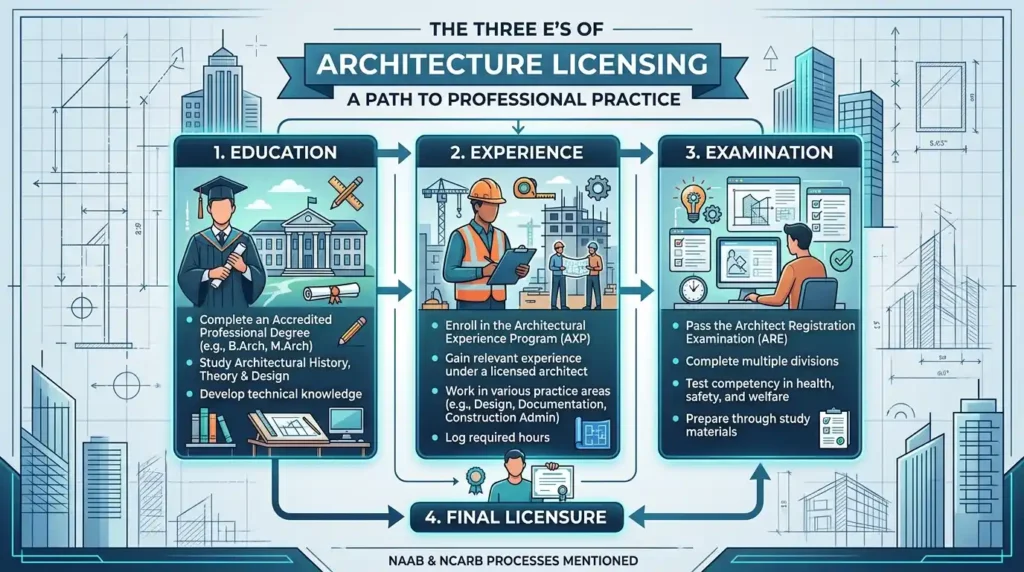
Currently, there are seventeen states in the US. Where you can take an alternate path when applying to the NCARB with no NAAB accredited degree. And it’s here that the number of years required depends heavily on your previous education. Four years of study in a pre-professional architecture program. Will mean nine years of working experience needed to become licensed without an accredited degree.
All other bachelor’s degrees or any higher degrees in fields unrelated to architecture. Would mean eleven years of professional experience. And for those entering the field directly from high school, it will be thirteen years. This information changes the way prospective architects have to look at their choice of programs. Since the five-year accredited degree is, in most cases, indeed a quicker path despite what it initially looks like.
Choosing the Right Architecture Degree and Navigating Alternative Pathways
A Bachelors of Architecture, referred to as a B.Arch, is an architecturally-focused curriculum, which often takes five years to complete, and consists of architecture studies, architecture design studio work, architecture thesis work, and in more cases, internship placements as part of the curriculum. In cases where someone has earned an undergraduate degree in other subjects, such as engineering and fine arts, even something completely unrelated like history, the Master’s of Architecture, or M.Arch is a more common option. The length of an M.Arch varies from just one year to five years, depending on how much of the existing education relates to the M.Arch curricular requirements
Accredited Online Architecture Degree
What would I tell someone looking at an accredited online architecture degree, an accredited part-time architecture degree, or the conventional path altogether? First of all, whether the degree is NAAB-accredited is more important than how that degree is structured. An NAAB-accredited online degree will take you through to licensure just like a campus-based degree would do. If your chosen degree is not NAAB-accredited and whatever form it takes, it will put you on the alternative path, which demands considerably more experience.
However, architecture schools now focus more on building information modeling (BIM), along with the basics of designing structures. The ability to use software such as AutoCAD, Revit, SketchUp, and Rhino is no longer optional; it is essential. UK references point out that the digital transformation that takes place with BIM plays an important role in setting the future direction of architecture, and BIM competency is being given great significance when it comes to hiring entry-level architects in firms in the US, UK, Australia, and Europe. If your course does not offer any training in BIM, you can learn it independently.
The AXP Experience Requirement and What 3,740 Hours Actually Looks Like
With the completion of your education requirement or even during its process, because AXP hours can be logged while you’re doing your studies, the Architectural Experience Program or AXP becomes the focal point. The total hours for AXP must come to 3,740 hours which should be divided into six different practice areas: Practice Management; Project Management; Programming & Analysis; Project Planning & Design; Project Development & Documentation; and Construction & Evaluation.
This is the surprising bit in the process of becoming an architect. Working in the firm for a number of years will not be sufficient. NCARB insists on having all your experience recorded for all six categories with your experience supervised by an architect who then validates your hours using your NCARB record. The intern architect who spends three whole years working solely on construction documentation can still lack hours in programming and analysis and practice management and such hours will have to be added in order for you to complete AXP.

The period of time required to finish the AXP varies tremendously on an individual basis; some finish in less than three years, provided their employer consciously switches them around in terms of which area of practice they work in, while others can take five or even six years, since their duties are more limited. But the straightforward truth is that, instead of trying to guess how many hours of what type should be accumulated, you should just have the discussion about it within your first month on the job.
Passing the ARE 5.0: Cost, Structure and Strategy
The Architect Registration Examination, ARE 5.0, is the final E and it’s the one most candidates underestimate going in. The exam consists of six computer-based divisions, administered at Prometric testing centers: Practice Management, Project Management, Programming and Analysis, Project Planning and Design, Project Development and Documentation, and Construction and Evaluation. Notice that these mirror the AXP practice areas almost exactly which means candidates who completed well-rounded AXP experience generally find the corresponding exam divisions more intuitive.
Each division costs $235, and uses a pass/fail scoring system. Across all six divisions, the ARE exam alone costs $1,410 and that’s before factoring in study materials, prep courses, or retake fees if a division doesn’t go your way the first time. The total cost to get an architect license, including application fees, license fees, and criminal records check fees, ranges from $1,510 in Pennsylvania to $1,760 in California, averaging $1,597 across most US states, with a standard application fee of $141.

Resources like Black Spectacles and its ARE Live podcast featuring resident architect Kiara Galicinao have become genuinely useful for candidates navigating exam prep, precisely because they break down each division’s content into manageable study blocks rather than treating the ARE as one undifferentiated mountain. Most candidates complete all six divisions over six months to two years, often passing some divisions on the first attempt and needing a second attempt on others which is normal, not a red flag on your application.
Salary, Career Path and What Happens After You’re Licensed
Salary
The return on investment varies greatly from one jurisdiction to another, based on firm size, and specialization. The salary range for a part 1/2 architectural assistant, who is still completing his/her qualifications in the field of architecture, is between £25,000 and £35,000. Individuals in the capital city of London and the larger companies earn much higher salaries compared to regional firms.
The individual needs to be registered with Architects Registration Board, abbreviated as ARB, before being referred to as an Architect, just as in the United States with regard to the title “Architect”.
Career Path
US employment outlooks for architectural and engineering occupations are predicted to increase by merely 3%, slower than the average job growth rate between 2022 and 2032; moreover, drafters and computer-aided design professionals may experience a reduction in employment by 4% because of automation and outsourcing challenges.
These very reasons explain the importance of acquiring software integration capabilities and practicing sustainable design among other critical qualifications of newbies who will become urban planners and design managers earning 20% to 40% higher salaries than entry level architects.
What Happens After You’re Licensed
Being licensed itself provides you with the right to sign and stamp drawings in which you have assumed professional liability. Additionally, a licensed architect can access opportunities unavailable to those who are not yet licensed. These opportunities include leadership roles in design firms, launching a private practice, offering consulting services, property development, and advising on sustainable building solutions.
If you are keen on working in fields such as residential architecture, commercial architecture, sustainable/green architecture, landscape architecture, interior architecture, or urban planning, then licensure is the step required to turn working in architecture to practicing architecture.

Conclusion
In conclusion, being an architect is a matter of having patience and doing things in the proper order receiving proper architectural education and getting AXP experience while learning to see it as a series of six exams, not one giant test. It will take you eight to twelve years from your first day in architecture school till you will be able to sign drawings that will be legal, yet at least you know you’ll have a chance to influence someone else’s life by creating wonderful buildings and places for people to work, study, and live in. So, if you have only started to pursue your goal of becoming an architect, it would be best to arrange the conversation now with your school concerning accreditation, and with your future employer concerning rotations of AXP program.
Frequently Asked Questions (FAQ’s)
The typical path combines an accredited architecture education, completion of required AXP experience, and passing all divisions of the ARE. Licensing rules can vary by state, so your jurisdiction ultimately determines the exact requirements.
A B.Arch is usually the more direct option for students beginning architecture after high school, while an M.Arch is often suitable for people who already hold another undergraduate degree. The better choice depends mainly on your previous education and whether the program meets accreditation requirements.
AXP requires documented professional experience across six defined practice areas under appropriate supervision. Candidates should track their hours carefully and seek varied responsibilities rather than spending all their time in one type of architectural work.
For most US candidates, a NAAB-accredited program provides a more straightforward route toward licensure. A non-accredited degree may still lead to licensing in some jurisdictions, but it can require substantially more professional experience.
According to the article, each of the six ARE divisions costs $235, bringing the examination fees to $1,410 before study materials, preparation courses, or possible retakes are added.

3 thoughts on “How to Become an Architect: The Real Path From Classroom to Stamped Drawings”