
It is not until one realizes that there is something wrong. That he or she gives any consideration to the art of interior design. While the living room looks disorderly, there is no clear reason why. Although the bedroom is meant to be calm, it fails to satisfy this condition.
The kitchen is doing everything right, although there is always something about it that leaves one disappointed. This contradiction between what it is seen and how it feels makes up interior design.
What Interior Design Actually Is
The definition of interior design, according to the International Interior Design Association (IIDA), is the comprehensive and professional practice of creating an interior environment in response to, in protection of, and in reaction to human needs. Interior design is the art, science, and business of formulating a functional and creative interior design. Which correlates to the architectural interior of a building while including process and strategies, health and wellness mandates, and making sound design and aesthetic decisions.
The above definition is quite broad. However, the more straightforward definition that dictates every design decision can be found at the New York School of Interior Design. Which defines interior design as all about spatial experiences. It is a vital element in our day-to-day existence, influencing our behavior, performance, recreation, and even healing processes.
Designing comfortable living spaces, designing productive workplaces, designing visually pleasing public places all these are examples of interior design at work. Whether you know it or not, you have been a participant in the design process for most of your life.
The Elements That Define Interior Design
Space Planning and Architecture
Every decision related to interior design starts with space itself. Architecture, including the size, ceiling height, window location, walls, and circulation pattern, becomes the limit in which all decisions must be taken.
Space planning is an art that arranges furniture and zones based on the limits created by the architecture. If a room is badly planned, regardless of the quality of its furnishings and the beauty of its colors, it will always lack something. The sofa blocking the natural way of movement, the dining room located too close to the wall, and the bedroom door swinging towards the bed are examples of badly arranged space.
Color, Light, and Texture
Colors are the first emotional element when designing an interior. They establish the mood even before any other aspect is considered. Warm colors generate coziness and excitement. Cool colors inspire tranquility and detachment. Neutrals create versatility and longevity. Patterns give personality and intrigue.
Natural light affects the way colors behave in a way that can’t be understood by a paint chip. What appears to be a simple gray when viewed on a paint chip becomes a lavender color when applied to a north-facing wall. The bright white color that shines in a brightly lit showroom appears yellowish on a room with less light. How light, whether natural or artificial, impacts the color of things within a room remains one of the most crucial aspects of interior design.
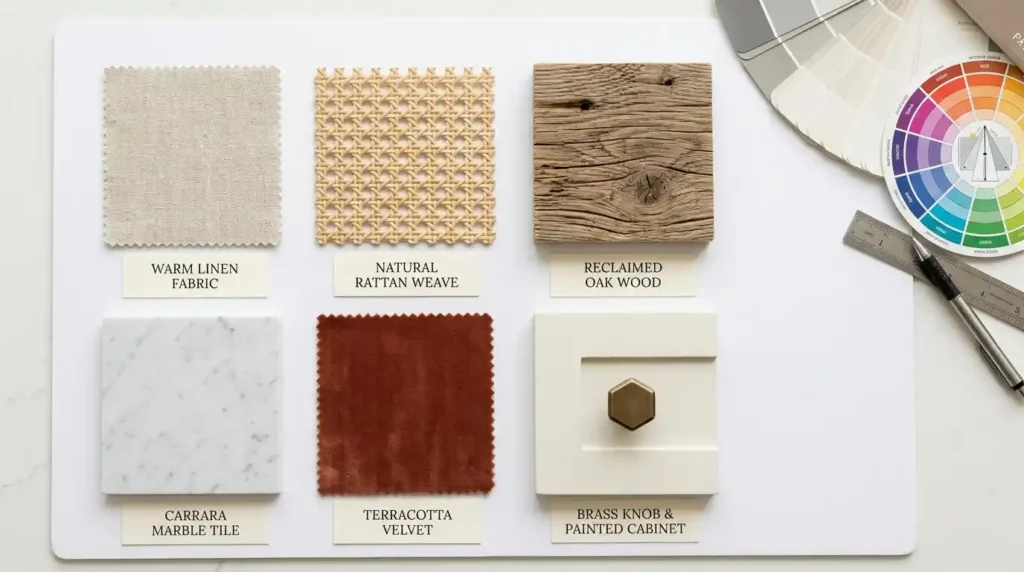
Adding textures to surfaces adds layers. Velvet brings in warmth. Linen feels more natural and relaxed. Bamboo and rattan add a natural feel. Marble is formal and cold. Old wood adds warmth and a sense of history.
Proportion, Scale, and Balance
Scale and proportion are the unseen structure of any room. A tiny couch in a spacious room will make the room look desolate, while an oversized couch in a small room will make it look like an assault. It is scale that distinguishes effortlessly put-together spaces from spaces that seem to have been a struggle.
Balance may occur in symmetrical form as elements that match on either side of a centering element or as an asymmetrical approach wherein there is a visual balance of disparate elements. Both forms are effective, but both require purposeful planning. A space which does not have a sense of symmetry or asymmetry but exists randomly is the reality of most peoples’ homes today, hence the lack of harmony.
Principles such as harmony, rhythm, emphasis, and unity are used by designers to coordinate how individual design elements work with one another. Focal points such as a fireplace, a large window or wall art create places for the eye to rest while rhythm created through repeated elements give the eye a place to go.
How to Design a Room A Step by Step Process
Step One – Set a Budget
Budgets serve as the groundwork for all decisions. Budgetless design is pure creativity; budgeted design is a strategy.
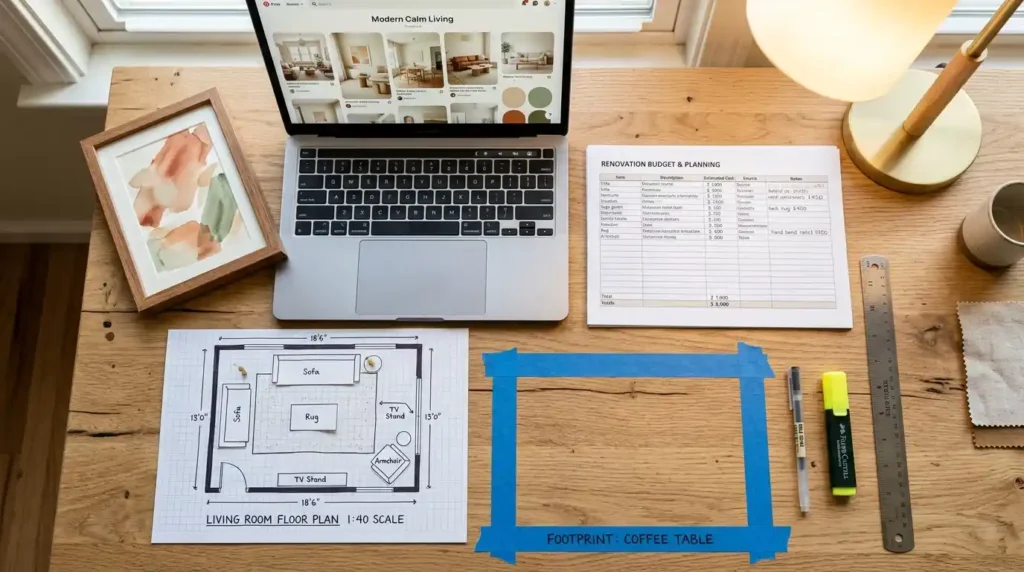
Begin by creating a spreadsheet with a list of every single component of your project furniture, paint, lighting, textiles, accessories etc., with budget estimates that are converted into solid figures as the components are sourced. Allow 10% to 20% overage. In cases of renovating kitchens in older homes, it is best to estimate a 20% overage. Soft furnishing renovations can suffice with an overage of 10%.
Always obtain 3 quotations for all construction. Be clear from the start regarding what you expect from your project manager a contractor that is always sandwiching your project in between others is going to cause you delays and possibly problems.
Step Two – Create a Mood Board
Before spending any money, create a mood board. This is not optional. A mood board is the plan that prevents the piecemeal look that results from buying things individually without a connecting design language.
Start with a Pinterest board. Pin rooms, color schemes, furniture, and accessories that appeal to you without preconceived ideas. Aim for approximately 50 pins before stepping back to assess. Look for the styles, colors, forms, and textures that keep appearing. Look for what consistently makes you feel good.
The pins will tell you things about your taste that your stated preferences may not. If you think you love bold color but your pins are full of light-neutral walls and clean-lined decor, your pins are not lying. Trust them.
Step Three – Choose a Springboard Object
A springboard item is one singular object whether it be a painting, a rug, an antiques piece of furniture, or even something from a thrift shop that inspires the direction and serves as the catalyst for the whole concept. This will become the foundation that everything else will revolve around.
This doesn’t have to be the most expensive item in the room. The springboard could be a vintage painting that determines the whole color scheme of the room, or an old limestone cocktail table that determines the tone and aesthetic of the entire space. The only requirement is that it makes you excited and gives your project a focal point.
Step Four Make a Scaled Room Layout Plan
This is the step people often overlook and regret later. Prior to buying any piece of furniture, make a scale drawing of the space. If you are using paper, let 1 square represent 1 foot; otherwise, you can use online tools like Roomstyler, AutoCAD, or SketchUp to plan your furniture layout.
Upon making the sketch either digitally or physically, lay out the actual footprint of each piece of furniture via blue painter’s tape on the ground and experience what it feels like in the space. Learn about standard dimensions for interior design; how far apart the sofa should be from the coffee table, the chairs from the walls, and other dimensions related to a bed. The layout that leaves only a passage of 12 inches between the sofa and the wall will leave everyone who uses the space frustrated everyday.
This is also the time to think about outlet placements, television placement and hanging, and lighting fixtures and their wiring requirements.
Step Five – Select Foundation Furniture
Foundation furniture is the large, expensive, long-term furniture that anchors the room a sofa, a bed, a dining table, a primary storage unit. Choose these pieces for versatility and longevity rather than for the specific style you currently love. Design tastes change. Seven years from now, you may feel differently about modern farmhouse than you do today.
A neutral couch paired with a simple cocktail table and a couple of leather armchairs gives you a foundation that can be completely transformed through accessories, textiles, and paint without replacing the major investment pieces. This approach foundation pieces that are streamlined and classic gives you future flexibility that more specific statement furniture simply does not.
On the practical side: if you have children, pets, or both, durability matters as much as aesthetics. Aniline dyed leather holds up to daily use and can be wiped clean. Crypton and Sunbrella fabrics are spill and stain resistant and have improved enormously since first appearing in home decor. Slipcovers work well on light upholstery that gets heavy use. Reupholstering an investment sofa almost always costs more than buying a new one it is usually not the economical strategy it appears to be.
Step Six- Choose Paint Colors
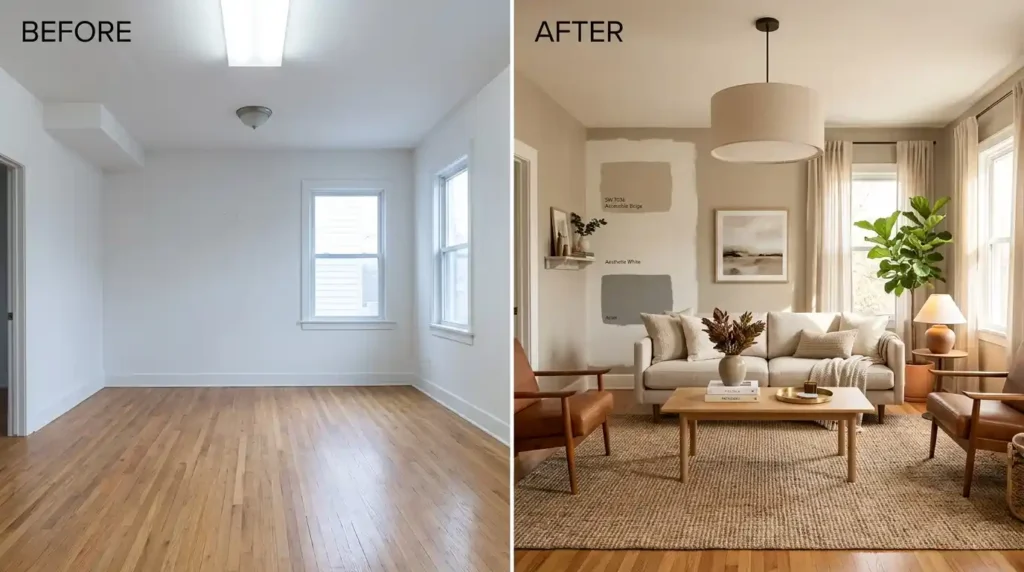
Nothing is as powerful as paint to change the character of a room as far as cost is concerned. And nothing holds as much potential for being disastrous as paint does.
Practical guidelines would be to always test the paint by actually putting it up on the walls, especially in the areas where the color of one corner reflects onto another. Don’t rely on seeing the color from the small chip only. Paint colors appear more vivid when covering walls compared to when they are only seen from a small chip what seems like a French lavender gray on the chip will seem like an alarming shade of purple on the four walls.
For neutral tones, determine your preference for cool or warm hues. Benjamin Moore Richmond Gray is more a neutral green than a neutral gray on the walls. Benjamin Moore Sea Haze is more of a neutral blue even if it looks gray on the chip. This is better known before hand to avoid waste of time and effort.
In the case of uncertainty, opt for recommended paints from designer’s palettes which have been verified in multiple references. They come with a higher degree of probability to work than any other randomly chosen color based off a chip.
Step Seven Scale, Mix, and Add Personality
Scaling up: opt for larger pieces of decoration over smaller ones. Having one big lamp with three well-selected objects arranged on a nightstand is far more elegant than having seven tiny objects clustered in one place. If you own a number of small decorative pieces, trays or serving plates will gather them into one group.
Mix it up: don’t get all your ideas from one style or one brand. A room that resembles one catalog is not very interesting at all. Rooms that really catch your attention always have a bit of a combination going on in there; a mid-century Tulip table paired with a farmhouse dining room, an industrial side table paired with a modern living room, French country textiles mixed into a Scandinavian setting, and so forth. How are these pairings possible? Through a common color scheme and/or texture story.
Every room needs some form of black charcoal, blackish green, or dark navy in order to create a dramatic effect. Dark colors are great for giving rooms more depth and balance. Lighter rooms especially need darker colors.
Accessories and accent tables, lighting fixtures, pillows, and plants can become a space all their own because that is where creativity comes into play. Accessories, whether it’s something you found at a thrift shop or some natural objects, metallic finishes, rustic furniture, or handmade items should all blend together here.
Interior Design Styles Understanding the Landscape
The Most Common Interior Design Styles
An understanding of the major design styles will make it easier for you to understand your own style and communicate it, either with yourself, your partner, or a designer.
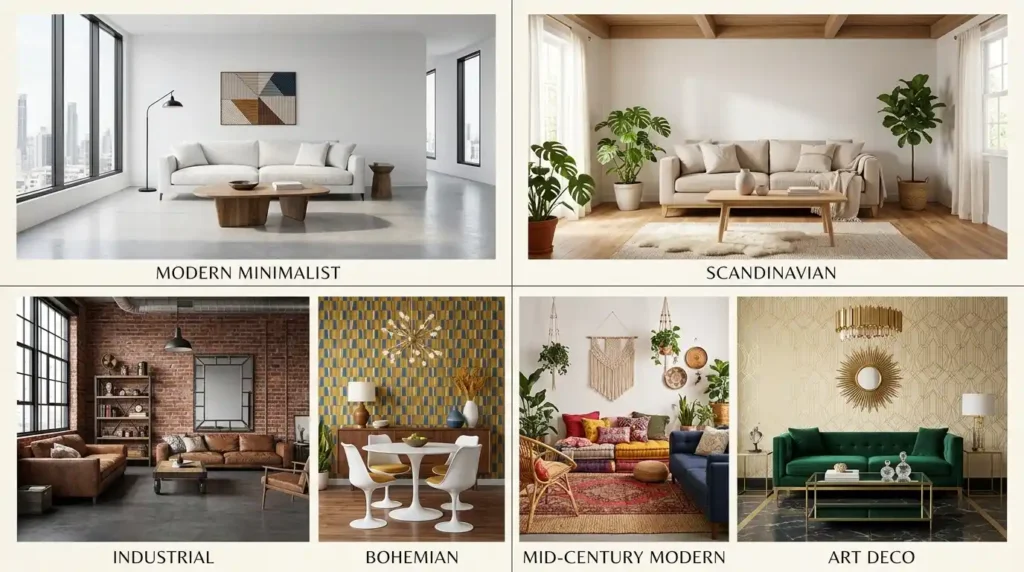
Modern and contemporary design stress straight lines, neutral colors, open plans, and uncluttered spaces. The minimalist approach goes even further, by removing anything that does not have a functional purpose or provide joy.
Traditional Style Designs
Designs inspired by the traditional style incorporate historical reference, architectural elements, symmetry, and vibrant fabric such as velvet, silk, and wool, all set in hues of brown and other rich colors. Designs classified as transitional include features of both traditional and contemporary styles and use a blend of classical proportioning and modern minimalism.
Functionality, natural elements, warm wood finish, and a neutral color scheme comprising whites, grays, and earthy tones characterize Scandinavian designs that focus on light, simplicity, and meaningful living. The Wabi-sabi design is a Japanese version of the Scandinavian concept, which appreciates imperfection, aging, and incompleteness.
Features such as exposed brick, bare concrete floor, high ceilings, expansive windows, and metals make industrial designs unique for their urban atmosphere. The bohemian design comprises a combination of several elements such as colorful fabric, vintage items, handmade furniture, and cultural artifacts.
Farmhouse And Coastal Designs
Farmhouse and coastal designs have a similar element of warmth and approachability in the former via reclaimed wood, shiplap, and linen, while the latter has it through the use of natural lighting, rattan, bamboo, and colors taken from the ocean, sand, and whitened wood.
The mid-century modern style, which emphasizes organic elements, geometric forms, wooden hues, and the belief that design can help achieve a better day-to-day experience, has become one of the most significant design trends in residential interior design.
Art Deco offers geometric patterns, luxurious materials, marbles, brass elements, and an unapologetically glamorous aesthetic. The maximalist and eclectic approach to design includes texture, art-filled walls, decorative items, and a conviction that more is indeed more.
How to Choose Your Style
There’s no requirement for you to settle on one particular style. Most successful-looking spaces tend to blend two or three styles but are anchored by a cohesive color scheme, a common textural narrative, and a focal point.
It doesn’t matter whether you’re working with a professional interior designer, using an interior design app, or going solo: You should define your vision of how the space should feel first, rather than deciding on how the space should look.
The mood board shows you what you really like. The scaled layout shows you what really fits. The foundation furniture serves as the platform. The paint defines the ambiance. And all the accessories, fabrics, lighting fixtures, and personal objects you’ll add last define the space uniquely as yours.
Conclusion
Interior design is not something that only rich and super-rich people can afford. Interior design is about understanding the basics and concepts of scale, proportion, balance, color, space planning, harmony, and personalization.
The New York School of Interior Design has been teaching the basics of interior design for more than a century already. IIDA or the International Interior Design Association is a community of interior designers who influence changes through their designs throughout the whole world. Whether the interior was created by a professional interior designer such as Robin Klehr Avia from Gensler or just a person on a tight budget, all the spaces that form the best spaces in the world share one characteristic: they were designed.First start with a budget. Create a mood board. Pick your springboard item. Sketch out your plan on paper. Decide what your foundational furniture pieces will be. Pick the right paint color. Amplify your accessories and mix it all.
Frequently Asked Questions (FAQ’s)
Interior design is the process of shaping indoor spaces so they are functional, comfortable, and visually balanced. It considers how people move through a room, use it, and respond to elements such as color, light, furniture, and layout.
Interior design starts with space planning, proportion, function, lighting, and architectural limitations, while decorating focuses more on finishes, furniture, and accessories. A successful room usually needs both practical planning and thoughtful styling.
Begin by setting a realistic budget, creating a mood board, measuring the room, and planning the furniture layout before making major purchases. These steps help prevent costly mistakes and keep the overall design consistent.
It is usually better to establish your layout and select important foundation furniture before finalizing paint. Paint is easier and less expensive to change, while large furniture pieces have a stronger long-term influence on the room.
There is no single best style because the right choice depends on how you want the space to feel and function. Many successful interiors combine two or three styles through a consistent color palette, texture story, and clear focal point.

17 thoughts on “Design in Interior by KD Architects — The Complete Guide to Creating Spaces That Work, Feel Right, and Reflect Who You Are”