
Certain concepts gain momentum that transcends the creator behind them. This is the case with the Lover House. A concept that initially began as an architectural piece used as a prop in one of Taylor Swift’s videos. The Lover House has since been transformed into a cultural touchstone and a creative exercise for Swifties all around the world and in some instances. A tangible item placed on the shelf.
This is everything you need to know about the Lover House its meaning, implications, inspiration, and purpose.
What Is the Lover House
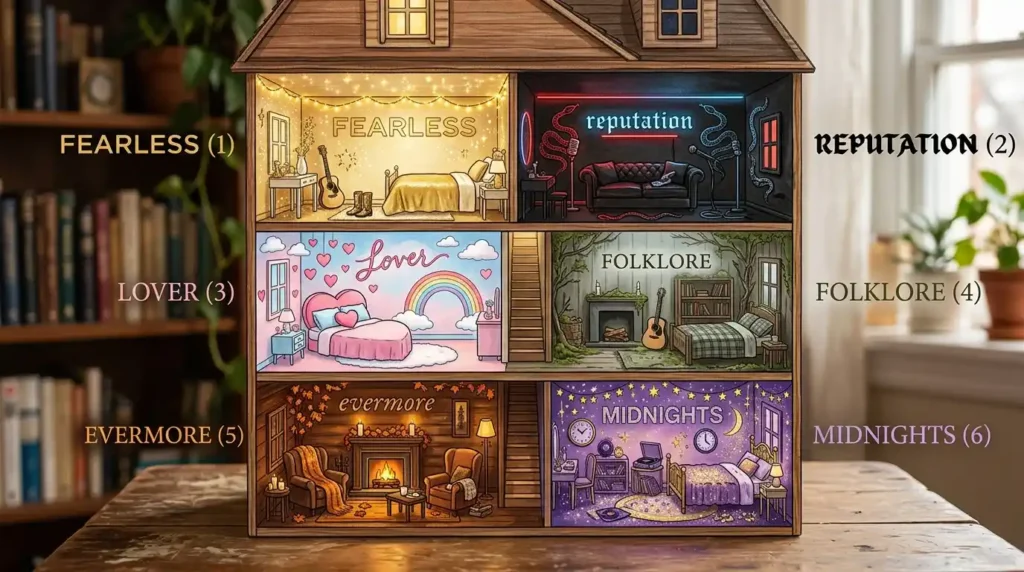
Lover House, alternatively known as Holiday House, is the vibrant-colored house featured in Taylor Swift’s song “Lover”. It is a many roomed and many colored building. That was referred to by Taylor Swift as a representation of her whole life of music. The concept was quite simple and beautiful in its simplicity. As each room of the house symbolizes a different album by Taylor Swift.
The comparison was made by Taylor Swift herself. Who stated that her musical collection is a representation of a house. Where each room corresponds to an album. For instance, Fearless may correspond to the living room, while Reputation is associated with the attic. The bedroom with the heart-shaped bed and a bright pink color scheme clearly corresponds to the album Lover.
This metaphor worked especially well, as it was easy to visualize and helped to categorize and interpret Taylor’s music better. This idea can be used not only to analyze albums. But also to discuss different aspects of her career and music.
Why the Lover House Metaphor Works So Well
The house metaphor works because houses are universally understood. Everyone has lived somewhere. Everyone knows what it feels like to be in a room that belongs specifically to one period of their life. The childhood bedroom that smells a certain way. The first apartment that was small and chaotic and completely yours.
Taylor tapped into that shared language when she described her albums as rooms. She was not just explaining her discography she was inviting listeners into a personal architecture. And fans responded to that invitation by taking it as literally as possible. Which is exactly the kind of creative energy that gives Swifties their reputation.
The Lover album itself is the most optimistic, most pastel, most unguardedly romantic thing Taylor has released. It is the room in the house that always has the lights on. And the Lover House as a visual colorful, layered, full of little details that reward close attention is the perfect physical expression of that emotional register.
The Student Who Actually Built the Lover House
In June 2024, Elly McCausland an English literature professor and the creator of Swifterature. A platform dedicated to the intersection of English literature and Taylor Swift published a student’s creative assignment that stopped a lot of people in their tracks.
The student, who had a master’s in history and described themselves. As what the kids might call a Swiftie, built a physical, architecturally sound replica of the Lover House as their final creative assignment for English Literature (Taylor’s Version). A course that linked Taylor’s albums to literary traditions, authors, and musical influences.
Idea Came In A Dream
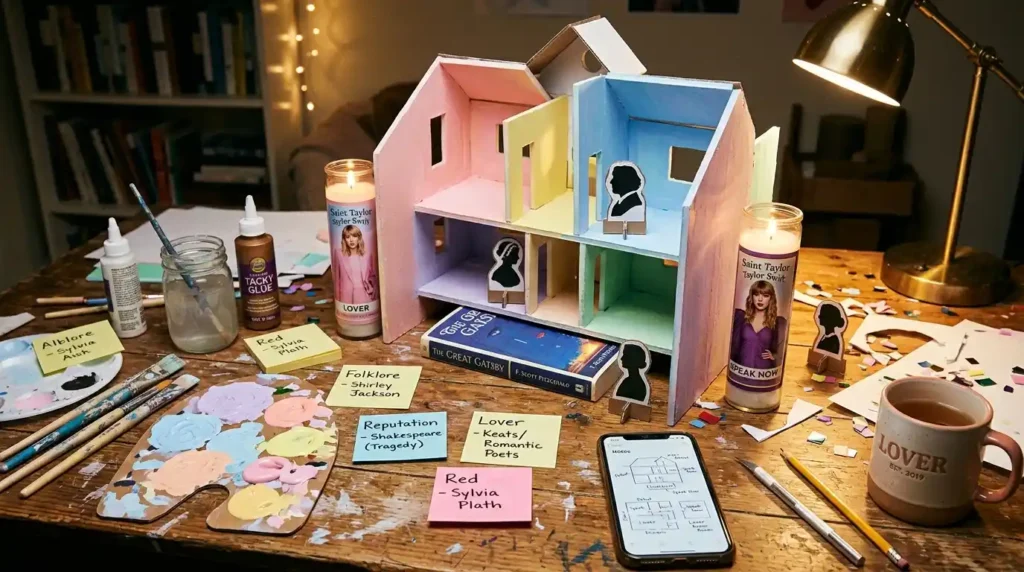
The idea came in a dream. The student had been thinking about inspiration in art specifically about. How Taylor had cited Joni Mitchell’s Blue as an influence on Red, partly as an indirect answer to a critic. Who had written that Miss Swift should listen to Joni Mitchell. They had been thinking about Dvorak’s 9th Symphony and its relevance to Reputation Taylor’s Version. And then the dream turned into a Post-it covered in notes, and the notes turned into a plan.
The plan was this: build the Lover House as a physical dollhouse. And populate it with cardboard cut-outs of the musicians and writers who influenced or embody each Taylor album one per room. Authors like Pablo Neruda and Louise Gluck, musicians like Justin Vernon. Each placed in the album room that best represented the connection the student saw between that creative figure and that chapter of Taylor’s work.
How It Was Actually Built
The build itself was not simple. The student consulted their cousin who studied architecture and design at LUCA and bought materials. That cost enough to make them look away when typing in their PIN. The construction process involved foam carton, building paste, and eventually the structural support of Saint Taylor Swift candles. Which the student credits as genuine building aids.
Each wall required 6 to 12 hours of drying time before the next could be attached. The foam carton tended to bend even in optimal storage conditions. Nothing would cut to a perfect 90 degrees no matter how carefully it was measured. The glue was runny. The edges were never quite perpendicular. And yet, wall by wall, the house became structurally sound.
Then came the painting of the rooms mixing paints to get the right shades, adding details that were strictly unnecessary but emotionally essential. Then came the dolls: printing full-body images of each musician and writer, sticking them onto cardboard, cutting out their silhouettes one by one. After the eighth doll the student had given up on cutting perfectly, just wanting each figure to stand in their assigned room and be done with it.
The final product a multi-room dollhouse populated with literary and musical figures, each placed in an album room that reflected their connection to a chapter of Taylor’s creative life was, by any measure, one of the more unusual and more moving student assignments in recent memory.
What the Lover House Meant to the Student
The student’s written reflection on the project is worth quoting in spirit if not in exact words. They described finding, through the process of building, something they had been thinking about for years as a historian: the idea that humans will keep trying to put things into words no matter how many times the same ground has been covered before. We keep writing love poetry. And we keep writing about grief. We keep making art for ourselves and for others.
They referenced Onfim’s 13th-century drawings and the Cueva De Las Manos alongside Taylor Swift’s evermore as examples of the same impulse the drive to express something that feels too large or too specific for ordinary language. They described spending hours on Tumblr looking at web weaving posts, in which pieces of art from entirely different traditions are placed next to each other to reveal an unexpected parallel or emotional connection.
That is what the Lover House became for this student not just a creative assignment, but a physical representation of the idea that inspiration travels across cultures, languages, and time, and that we carry pieces of everyone who has ever made something beautiful inside us, whether we know their name or not.
The Walmart Block Set A Different Kind of Building Project
On the more commercial end of the Lover House spectrum, in March 2025 a reviewer named Angel Madison published a detailed review of the Music Themes Lovers House Building Block Set a 1,426-piece building block set available at Walmart for $90, or $79.99 at time of purchase.
The set is not officially licensed by Taylor Swift, which Madison noted with some discomfort as a committed Swiftie. It is designed to replicate the Holiday House from the Lover music video and is described by the listing as suitable for ages 6 and up though Madison, who is 50 years old and builds Lego sets, crafts, and puzzles regularly, found it challenging enough that she almost needed help at multiple points.
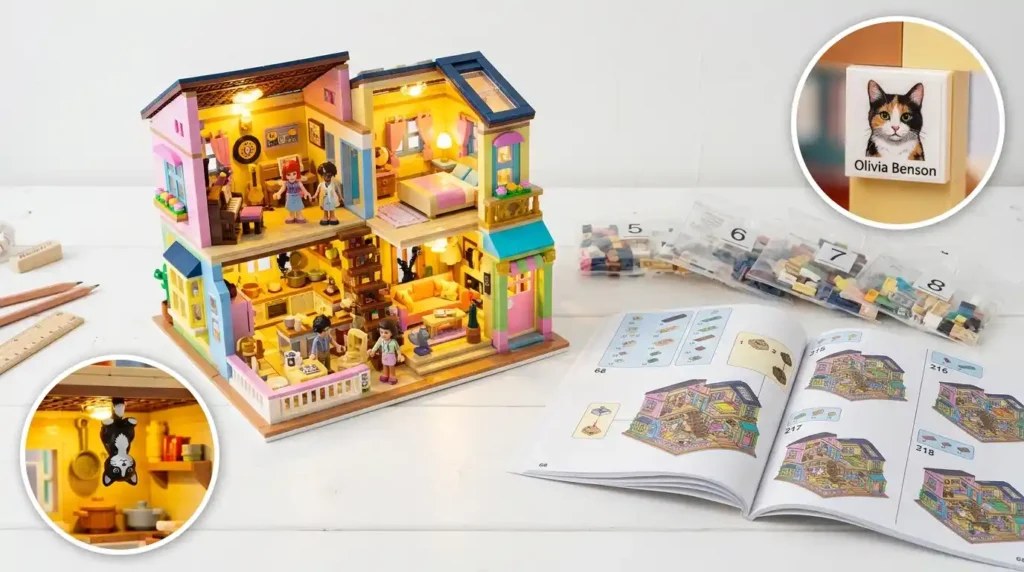
The build experience had real problems. The instructions were unclear at key moments. The brick packages were mostly numbered but included at least one large unlabeled bag that required lengthy hunting through pieces to match the assembly manual. The bricks themselves lacked the satisfying snap of Lego bricks many required significant force to connect securely, and several were misprinted with incomplete ridges or rough edges that were noticeable in the finished product.
What the Block Set Gets Right
Despite the build frustrations, Madison had genuine praise for the details. A small cat hanging upside-down from the kitchen ceiling. Clothes built onto hangers in the stairwell. Tables set with food. A projector and fan in the attic. Star pieces arranged across the entryway wall like wallpaper. Cabinets and doors that open and close. A half circle piece that slots into the wall to create a fishbowl in the blue bathroom.
The bricks are in vibrant colors that closely match the music video. There are no stickers anywhere in the set all details are pre-printed directly onto pieces, which meant Madison could giggle with genuine delight at the tiny portrait of Taylor’s cat when she encountered it in the build.
LED Lighting System
The best and most frustrating feature is the LED lighting system. The small lights run on strings that connect to a circuit powered by a USB-C cable a charging block is not included. The lights are multiple colors rather than white, which alters the appearance of the rooms when illuminated. Getting the wires to fit correctly into the light fixtures required disassembling and reassembling sections of the build multiple times. Madison recommends testing the lights and circuits as you go rather than waiting until the structure is complete.
The finished result looks truly charming when the lights are turned on. Madison admits she is still working on forgiving the unofficial licensing because the finished product on her desk is hard to be annoyed at when it is glowing.
Who Keeps Building the Lover House and Why
The common thread between the student’s handmade architecturally sound replica and Madison’s review of a Walmart block set is the same instinct that drives all fan creativity: the desire to make something tangible out of something that moved you.
Taylor’s body of work is, by design, deeply specific. The details in her lyrics the chipped paint on the door frame, the incense dust on the vinyl shelf, to quote Taylor’s own description of her Fountain Pen writing style create the impression of a world you could actually visit. The Lover House takes that impression literally. It is the visual proof that a world exists behind the words.
That is why people keep building it. In cardboard and building paste, with Saint Taylor Swift candles holding the walls in place while the glue dries. In 1,426 plastic bricks shipped from Walmart and assembled on a kitchen table over a weekend. Across Reddit threads and Tumblr posts where fans have mapped the rooms and debated which album belongs in the attic.
The Lover House is not just a music video set piece. It is a shared imaginative space that Taylor built and then handed over to her audience, who have been furnishing it ever since.

Conclusion
The Lover House is one of the most effective creative metaphors Taylor Swift has ever offered her audience, and that is a high bar. The idea that a body of work is a house that each album is a room with its own light, its own furniture, its own emotional temperature gave fans not just a way to think about the music but a way to enter it.
Whether you are a history student spending 6 to 12 hours gluing walls of foam carton together and populating rooms with cardboard silhouettes of Pablo Neruda and Justin Vernon, or a Lego loyalist ordering a 1,426-piece Walmart block set for $90 and battling unclear instructions and misprinted bricks for a weekend, the underlying impulse is the same. You want to stand inside the thing that moved you, even if standing inside it means building it yourself first.That impulse to express, to build, to connect is the same one the student writing their assignment found reflected in Onfim’s 13th-century drawings and Taylor Swift’s evermore. It is as old as art itself, and as current as the latest Swiftie posting their replica on Tumblr at two in the morning, waiting for the glue to dry.
Frequently Asked Questions (FAQ’s)
The Lover House is the colorful, multi-room house associated with Taylor Swift’s “Lover,” with its rooms used as a visual metaphor for different albums and stages of her musical career.
In the article, Lover House is also referred to as Holiday House, particularly when discussing the colorful house recreated by fans and in building sets inspired by the “Lover” music video.
A handmade replica can be created with materials such as foam carton, building paste, paint, and printed cardboard figures. Careful measuring, long drying times, and extra structural support may be needed to keep the model stable.
The handmade version described in the article was a custom academic project connecting albums with literary and musical influences, while the Walmart version is a 1,426-piece commercial building set designed to recreate details from the music video.
It may appeal to dedicated fans who value colorful details and LED lighting, but the article also notes unclear instructions, difficult brick connections, and the fact that the set is not officially licensed by Taylor Swift.

1 thought on “Lover House by KD Architects | The Complete Guide to Taylor Swift’s Most Beloved Architectural Symbol and How Fans Keep Building It”