
Most people think an architect draws buildings. That’s the image someone bent over a drafting table, pencil moving across a large sheet of paper, conjuring rooms and rooftops out of nothing. And while that image isn’t entirely wrong, it’s a fraction of the full picture. What is architecting, really? It’s the full act of conceiving, defining, planning, and guiding a structure from an abstract need into a physical, liveable reality. It’s spatial problem-solving layered over technical precision, regulatory compliance, client needs, environmental constraints, and a stubborn insistence that the end result must feel right for the people who will actually use it every day.
I’ve spent years working through this process on residential and commercial projects, and the one thing I keep coming back to is this the design itself is rarely the hard part. The hard part is everything that shapes the design before a single line gets drawn.
The Act of Architecting: Conceiving, Not Just Creating
Architecting is a verb. It describes an active, ongoing discipline not a single moment of inspiration but a structured series of decisions that compound on each other from site analysis to post-occupancy. The IEEE/ISO standard definition frames it as the process of conceiving, defining, expressing, documenting, communicating, certifying proper implementation of, maintaining and improving an architecture throughout a system’s life cycle. That was written about software systems, but it maps cleanly onto building architecture because the underlying logic is identical. You are not producing a drawing — you are managing the evolution of a design idea through layers of real-world constraint until what you’ve imagined can actually be built.
The architecting process starts well before schematic design. It begins the moment a client describes a need. A family that needs more space. A homeowner who wants natural light in every room. A developer who wants a mixed-use building that earns its footprint in a dense urban block. The registered architect’s job, from that first conversation, is to translate those ambitions into a design brief that is honest about what’s achievable not what’s aspirational in theory but structurally, financially, and legally buildable in practice.
What Architects Actually Do Across the Design Process
The architectural design process moves through defined phases, and understanding how they connect is what separates good architectural thinking from disjointed problem-solving.
Pre-design comes first site selection, site analysis, feasibility study, zoning analysis, cost analyses, understanding of applicable zoning ordinances and local authority regulations, and a thorough read of the project’s environmental impact and ecological constraints. This is the groundwork phase. In residential projects especially, insufficient work here shows up later as on-site improvisation, inconsistent ceiling heights, or budget overruns that nobody saw coming.
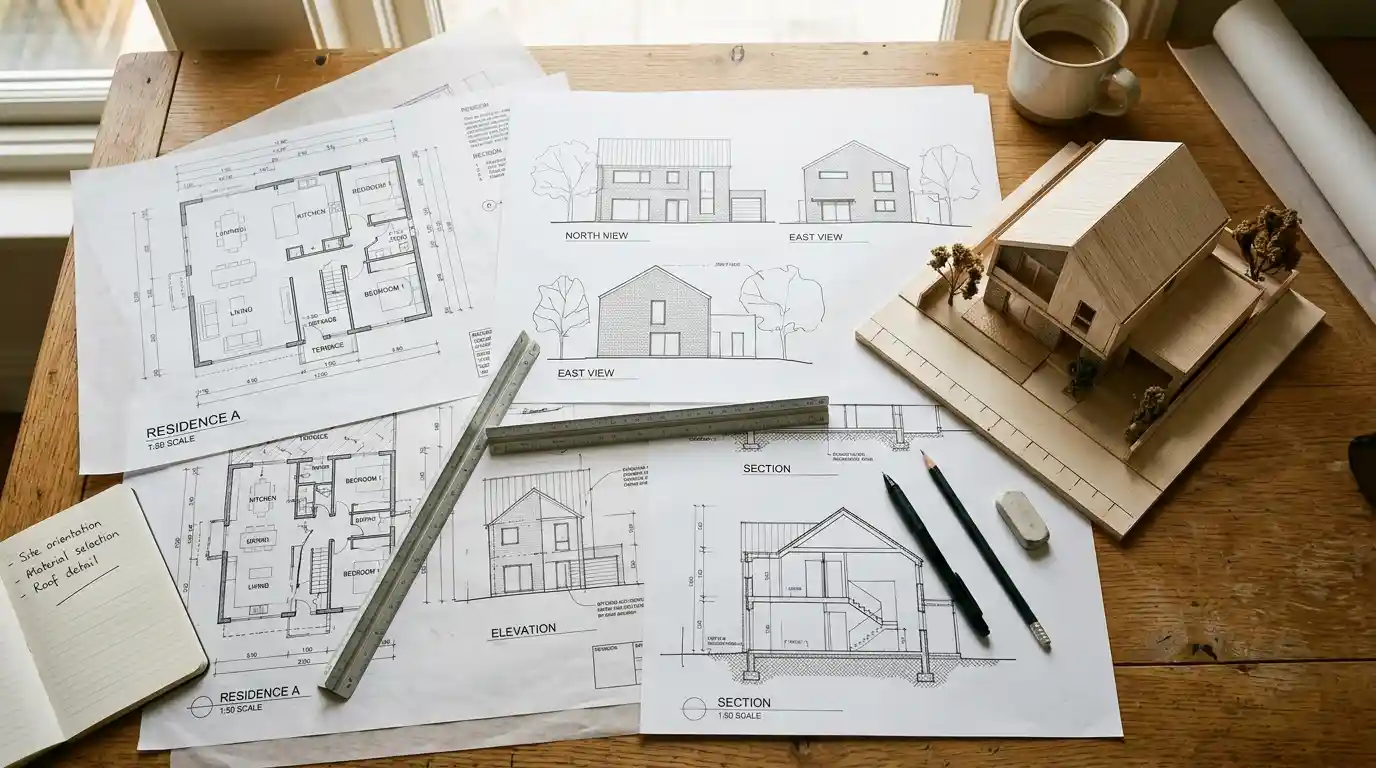
Then schematic design: this is where the overall design vision begins to take form. Conceptual design, spatial layout, floor plans, initial elevation drawings, and section drawings all emerge here. The architect develops two or three design directions, each reflecting a different interpretation of the client brief, and the client chooses a path forward. What looks like a creative exercise is actually a structured act of design thinking testing proportion, balance, human scale, light and shadow, form and function against the realities of the site and the budget.
Design development refines what schematic design established. Material selection decisions get made. Structural calculations are introduced. Building envelope performance, natural ventilation strategy, thermal performance, and energy efficiency requirements all get woven into the evolving design. Sustainable materials like bamboo, stone, or cork might enter the conversation here alongside renewable energy sources and passive design strategies. Every decision at this stage has a downstream consequence on cost, structure, and lived experience.
Construction documents follow the phase most people outside the profession never see, but arguably the most consequential. Blueprints, architectural drawings, detailed specifications, technical documentation. Building codes, regulatory compliance, safety standards, structural integrity requirements all verified and coordinated with the structural engineer, mechanical engineer, electrical engineer, quantity surveyor, and the broader design team. The construction documents are not paperwork. They are risk management. An incomplete set of construction documents is how a project ends up at a regulator’s desk twice, or how a contractor makes an on-site decision that contradicts the design intent entirely.
Construction administration is the final formal phase periodic site visits, reviewing requests for information from the builder, issuing architect’s supplemental instructions, confirming that the physical construction aligns with documented design intent. The principal architect doesn’t live on site, but they remain the last line of accountability between what was designed and what gets built. For a look at these same phases from the client’s side of the table what you’re actually paying for at each stage What Do Architects Do covers the same ground with a more client-facing lens.
Spatial Problem-Solving Within Layered Constraints
Here’s what architecture school teaches you and what practice confirms: architecting is iterative calibration, not aesthetic improvisation. The design that feels inevitable once it’s built was rarely obvious at the start. It emerged through a process of testing ideas against constraints budget, structure, planning permission requirements, client preferences, environmental factors, site topography, climate conditions, and soil composition.
A homeowner might want expansive glazing for natural light on a north-facing elevation. The structural calculations come back requiring additional reinforcement that eats into the budget. The energy efficiency modelling suggests the glazing ratio needs reducing to hit the thermal performance targets. So the design adjusts not as a failure but as the ordinary iterative reality of what architecting involves. Balancing form, function, and budget while translating a client’s vision into something tangible is not a single act. It’s a continuous negotiation.
This is also why the roles involved in architecting matter. The licensed architect is not working alone. They coordinate with structural and mechanical engineers, collaborate with interior designers and landscape architects, work alongside contractors and city planners, and remain answerable to the client throughout. The urban planner considers how the building sits within the broader built environment. The landscape architect extends the design thinking into the site itself. The interior architect manages how spatial experience unfolds inside the building proportion, scale, the rhythm of rooms, the way natural light moves through the day.
Design Language, Aesthetics, and What Actually Makes a Building Feel Right
Architecting isn’t reducible to technical execution. The reason a building feels right or doesn’t comes down to decisions that live at the intersection of aesthetics and structure. Architectural style, facade design, the relationship between interior spatial quality and exterior form, the use of vernacular architecture references in a contemporary design language, the choice between minimalist architecture and a more textured material palette these are not decorative choices. They determine how the building ages, how it relates to its neighbours, and whether the people inside it feel the design was made for them.
I’ve seen technically correct buildings that feel hollow. All the structural calculations verified, all the regulatory boxes ticked, and yet the spatial harmony is missing. Something about the ceiling heights doesn’t sit right. The proportion between window and wall is slightly off. The balance between symmetry and visual interest tips too far in one direction. These things are hard to name on a drawing but impossible to ignore once you’re standing inside the finished space. That quality the capacity to anticipate how a space will feel when occupied is what distinguishes architectural thinking from technical drafting. It’s built through experience, through walking through completed projects, through understanding that human scale is not a measurement but a feeling.
Regulatory Reality: The Part That Determines Whether It Gets Built at All
The permission structure around any architectural project is not an obstacle to good design. It is a framework within which good design has to operate. Building codes exist because structural safety matters. Zoning ordinances exist because individual buildings exist within shared urban and suburban contexts. Planning permission exists because a structure that stands for a hundred years is a public act as much as a private one.
A principal architect navigating a residential project in Edinburgh, a commercial development in Toronto, or a renovation in a dense European city block is working with different specific regulatory requirements but the same underlying logic: the design must be defensible in every dimension. Certificate of occupancy isn’t issued until every required inspection is passed. Municipal codes govern setbacks, height limits, permitted uses. The design team’s job is to understand these constraints from the start, not to encounter them midway through design development when changes are expensive and the client relationship is strained.
The 5 phases of the architectural design process pre-design through construction administration exist specifically because architectural practice has learned, over centuries of building, that skipping stages creates problems downstream. Every step in the process exists because someone, somewhere, skipped it and paid for it in the built outcome.
Architecting as a Career, a Practice, and a Discipline
Becoming a licensed architect typically takes 5 to 7 years from the start of formal education to licensure a B.Arch or M.Arch programme followed by supervised professional practice and licensing examinations. The architecting discipline draws on architectural history, structural theory, environmental science, materials technology, project management, and professional ethics. It is, genuinely, one of the broader educational commitments in any professional field.
The career path progression of an architect moves from architectural designer through senior design roles to principal architect or design director. Some architects specialise residential architecture, commercial architecture, heritage architecture, adaptive reuse, landscape architecture, sustainable architecture, parametric architecture, urban architecture Types of Architects breaks down these specializations in more detail, including what each one actually pays and which projects call for which specialist. If you’re trying to find the right professional for your project, our guide on house designers near me covers exactly what to look for before hiring anyone.”
Others maintain a generalist residential and commercial practice and develop deep expertise in a geographic context, understanding local planning authorities, material suppliers, contractor networks, and the specific texture of the built environment they work within.
What stays constant across every specialism and every scale is the core act of architecting taking a complex, sometimes contradictory set of human needs and translating them, through a rigorous and iterative design process, into spaces that work, that last, and that feel like they were always meant to be there.
Conclusion
So, what is architecting? It’s the disciplined act of turning human need into built reality not through a single moment of design inspiration, but through a layered, iterative process that demands equal parts creative vision, technical precision, regulatory awareness, and honest client collaboration. Every phase, from the first site visit to the final construction inspection, exists for a reason. Every decision compounds on the one before it. The spaces that feel effortless to live and work in are almost always the product of an architecting process that was anything but one where a skilled architect quietly absorbed complexity so the finished building doesn’t show the struggle, only the result.
Frequently Asked Questions (FAQ’s)
Architecting is the process of turning a client’s needs into a buildable design through planning, technical coordination, documentation, and construction oversight. It involves far more than simply drawing a building.
Architecting involves solving spatial, structural, regulatory, environmental, and client-related problems throughout a project. Drafting focuses more narrowly on producing the drawings and technical information that communicate those decisions.
The process typically moves through pre-design, schematic design, design development, construction documents, and construction administration. Each stage develops and tests the project in greater detail before and during construction.
Site analysis helps identify zoning limits, environmental conditions, topography, climate, feasibility issues, and other constraints before major design decisions are made. Addressing these factors early can reduce costly changes later.
A licensed architect is particularly valuable when a project involves structural decisions, planning permission, building-code compliance, complex renovations, or coordination between multiple construction professionals.

6 thoughts on “What Is Architecting? The Full Design Process Most People Never See”