
There’s a version of the commercial architect conversation. That happens entirely in the abstract fee percentages, phases, deliverables. And a version that happens when a developer is standing on an empty site in Houston. Or a retailer is staring at a lease for a shell space in a New Jersey strip mall. Genuinely unsure what they’re supposed to do next. I’ve sat in both conversations, and the second one is always more useful. Once a project has a real context a building type, a site condition, a business. That needs the space to perform in specific ways the role of the commercial architect becomes concrete rather than theoretical. This guide is written for that version of the conversation.
The commercial architect is one. Who focuses his efforts and talents towards designing buildings for commercial, industrial, manufacturing, retail, and institutional use. It would be a mistake to say that. What makes a commercial architect distinct from a residential architect is simply the difference in the scale or cost of a project. Although both professions involve designing buildings, the scope, regulations, and project responsibilities differ significantly. If you’re planning a home instead of a commercial development, our article on Residential Architect explains how residential projects, design priorities, and client collaboration compare with commercial architectural services.
What makes the difference is the regulation involved, stakeholder management issues, specialized technical knowledge. And the legal responsibility of having a professional seal and submission of documentation by that same individual representing the client. Commercial buildings are some of the most complicated building projects. And the commercial architect is responsible for tying it all together.
The Five Phases of Commercial Architectural Services and What Each One Actually Delivers
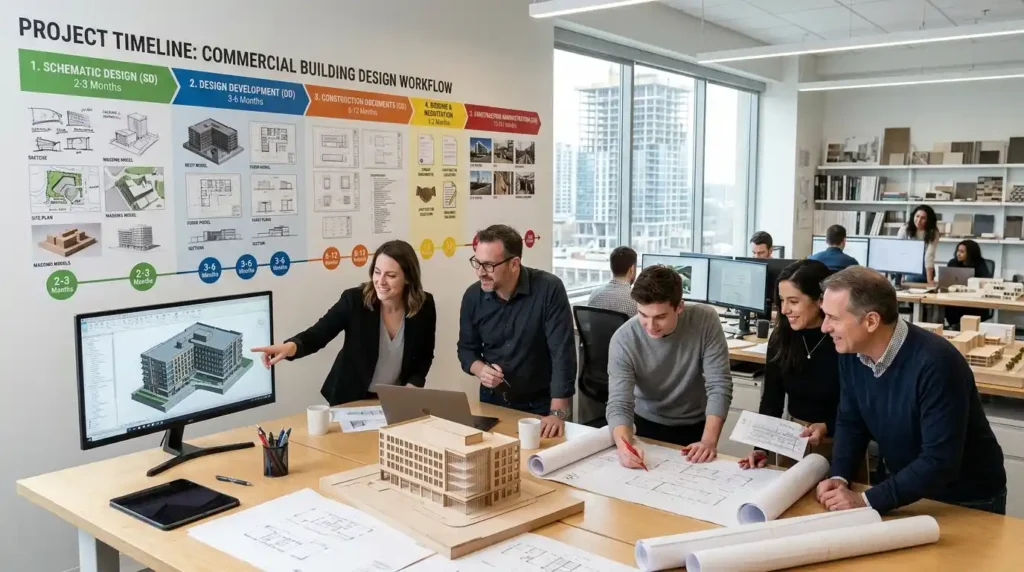
The phases in the commercial architecture project are the “Basic Services five phased process of the American Institute of Architects”. That take an idea from inception to completion in the building. Knowing what occurs during each of these phases is important for a client in order to have reasonable expectations. And not fall into the trap of assuming that paying an architect results in drawing delivery.
Schematic Design
Schematic design is the first phase and typically accounts for 15% of total architectural fee distribution. This is where the commercial architect translates the client’s brief spatial requirements, brand identity, budget parameters, site constraints into preliminary floor plans, section drawings. And massing studies that establish the project’s design intent.
For a corporate office architect. Schematic design might produce three distinct workplace layout options with different approaches to hybrid workplace design and activity based working. For a healthcare architect designing a medical office. It might explore patient flow, medical equipment coordination, and therapeutic design principles. Before a single wall thickness is committed to paper.
Design Development
Design development carries approximately 20% of the fee. And refines the approved schematic design into a coordinated set of drawings. That resolve MEP mechanical electrical plumbing coordination, structural engineering coordination, civil engineering coordination, and landscape architecture coordination simultaneously. This is the phase where the building starts to feel real dimensions are confirmed, material selections begin. And the building envelope assessment takes shape.
For a hospitality architect working on a hotel or restaurant. This phase is where guest experience design and customer flow through public spaces gets resolved in three dimensions. For a retail architect, it is the point where customer flow, store layout planning. And ADA accessibility requirements are integrated into a cohesive design.
Construction Documents
Construction documents the CD phase typically takes 40% of total fee, and deservedly so. This is the most labor-intensive and technically demanding phase of commercial architecture. The commercial architect, often acting as Architect of Record, produces permit ready construction documents. That meet local building codes, IBC International Building Code requirements, zoning law compliance specifications, fire code compliance standards, OSHA safety standards. And ADA compliance requirements simultaneously.
These documents serve as the foundation for construction, are reviewed during the permitting process. And remain the professional responsibility of the Architect of Record. In BIM enabled projects now standard practice in most commercial architectural firms using AutoCAD, Revit, and SketchUp platforms. This phase is increasingly frontloaded with energy modeling, 3D rendering coordination. And smart building technology integration that reduces coordination errors during construction.
Bidding And Negotiation
Bidding and negotiation, at roughly 5% of the fee. Covers the commercial architect’s involvement in contractor selection and construction cost validation. Construction administration the final phase at approximately 20% of fee keeps the architect actively engaged during the build itself. Reviewing submittals, responding to requests for information, conducting site visits. And managing change order management when construction realities diverge from design documents.
It’s also the phase where site safety oversight and health and safety construction compliance becomes the architect’s shared responsibility alongside the construction manager and general contractor.
Commercial Architect Types: Matching Specialization to Building Type
The commercial architect field encompasses many types of buildings. And specializing in it becomes more important than clients expect before beginning the process. For example, an office architect with plenty of expertise designing corporate offices does not necessarily have the skills to design a complicated industrial structure.
Similarly, a retail architect who is highly skilled at designing shopping centers and retail establishments focused on customer interaction might not know enough about healthcare buildings that are designed around patient safety. Examining the commercial architect’s portfolio for similar work done previously is the best possible indicator of success.
Architects Who Design Office Spaces
Architects who design office spaces are specialists in creating designs that increase efficiency and promote employee wellness in the workplace. With the rise of hybrid work environment and activity based working in 2026, corporate office architecture has become a highly technical field. The brief for an architect has evolved beyond the basic “desks and conference rooms” into the more complex mix of communal spaces, personal spaces, and tech integration.
Healthcare Architect
The job of a healthcare architect requires working on healthcare facilities such as medical offices, hospitals, medical centers, and assisted living environments under one of the toughest regulatory regimes in commercial construction projects.
The patient safety rules, medical equipment coordination, and compliance with healthcare building standards among others contribute to making healthcare architecture one of the specialties within commercial architecture that demands some of the highest fees paid to commercial architects. Data center architects, like healthcare architects, are also among those who deal with technical complexities.
Architect Who Specializes In Hotel Architecture
The architect who specializes in hotel architecture is concerned with both the efficiency of operations as well as the designing of the guest experience. On the other hand, the industrial architect, whose concern involves the planning and designing of manufacturing plants as well as warehouses, would have an entirely new challenge which revolves around logistics, loading docks, bearing capacity, and workflow efficiency.
Institutional architects who design schools, government facilities, stadiums, and recreation centers must address a wide range of functional, regulatory, and community focused requirements. Many public-sector projects require additional oversight, procurement procedures, and strict compliance standards beyond those found in private developments. Our article on Federal Architects explores how architects working on government buildings manage these unique responsibilities and regulatory requirements.

Commercial Architect Fees: How Percentage, Hourly and Per Square Foot Pricing Actually Work
Architects’ fees can be based on percentage, hourly rate, and per square feet fees. Each fee structure is more suited for certain projects than others. The fees charged based on the percentage of construction cost dominate the full-service commercial projects; such fees are typically between 3%-12% of total construction costs.
The range of percentage fees will depend on the complexity of the projects and whether the design process requires more or less coordination, regulatory requirements, and documentation. For example, fees for simple building projects such as warehouse and parking garages will fall between 3%-9%, 4%-10% for office buildings, and 5%-12% for hospitals. In Texas, fees in the range of 6%-12% apply to office buildings.
Costs Of Commercial Architectural Fees
The costs of commercial architectural fees have risen to between 8 percent and 12 percent as of 2025 from traditionally low percentages due to the requirement for BIM integration, higher code complexities due to changes to building codes in 2026, and sustainable considerations adding up to between 5 percent and 10 percent to traditional baseline fees for most construction projects.
These rising fees correspond with additional costs associated with BIM projects, including transferring large amounts of work to early stages, utilizing energy modeling, and integrating intelligent building systems.Understanding what clients pay is only one side of the equation. If you’re curious about how architectural fees translate into professional earnings, our guide on Commercial Architectural Fees explains how project pricing, experience levels, firm size, and specialization influence an architect’s income.
Hourly Rate Billing
Hourly rate billing at $100 to $250 per hour applies typically to partial service engagements, feasibility studies, due diligence assessments, and additional service scopes beyond the original contract. Per-square-foot pricing at $2 to $15 per square foot provides useful preliminary budget clarity but rarely captures the full scope of commercial architectural services particularly for adaptive reuse, commercial renovation, or commercial tenant improvement projects where site specific complexity drives fees more than gross floor area does.
NAAB Fee Guide
The NAAB fee guide categorizes commercial buildings into Groups 1 through 5 by project complexity, with basic architectural fees ranging from 6.5% for construction budgets over $50 million down to 12% for projects under $100,000. As total budget increases, the fee percentage typically slides down which means a $500,000 restaurant renovation and a $50 million hospital expansion can both fall within the commercial architect fee range but at very different percentage points on the curve.
Vetting, Selecting and Working Effectively With a Commercial Architect
While discussion on commercial architects’ selection guide begins with portfolio inspection, this should not be where it ends. Past successful completion of projects with similar scope suggests future success for your project; however, it is equally important to discuss how compatible they are in terms of process. Inquire about whether they have experience dealing with permit requirements and their interactions with the zoning department on projects with similarities like yours. You will pay more in fees for an architect who does not need several cycles of document resubmission to get a permit than someone who always needs several.
Ask how they handle change order management and mid project design modification changes during construction are inevitable, and the quality of the process around them determines whether they’re absorbed smoothly or become contentious. Understanding their construction administration approach, site visit frequency, and how they coordinate with construction managers on site safety and health and safety construction compliance also matters, particularly for complex commercial renovation projects or commercial adaptive reuse scopes where construction reveals conditions the documents couldn’t anticipate.
Commercial Architect Vetting Checklist
Commercial architect vetting checklist essentials: comparable project portfolio, license verification, professional liability insurance, references from recent comparable clients, demonstrated local building code expertise, BIM capability for your project scale, and transparent fee proposal with clear phase by phase breakdowns.
A commercial architect who won’t provide an itemized fee structure is telling you something important about how the engagement will be managed which is exactly the kind of signal worth acting on before a contract is signed rather than after.
Conclusion
Choosing a commercial architect should not be based solely on finding the lowest-cost option or treating the process as a simple transaction. This architect represents an individual who has his or her license, qualifications, and skills which should be regarded as central in a complicated process where construction managers, engineers of various specialties, MEPS, and those who will actually use the building are involved.
Choosing the architect that fits the type of your project in terms of specialization, comprehending how the fee is structured prior to signing the contract, and acting early enough to participate in the decision making that will have repercussions for each next stage of the process are the criteria that will determine if the project was successful.
Frequently Asked Questions (FAQ’s)
A commercial architect designs and coordinates buildings used for offices, retail, healthcare, hospitality, industrial, and institutional purposes. Their work covers design, regulations, technical documentation, consultant coordination, permitting, and construction oversight.
A commercial architect works with more complex regulations, larger stakeholder groups, specialized building systems, and business-focused spaces. Residential architects generally focus on homes, where privacy, lifestyle, comfort, and household needs shape the design.
Commercial architect fees commonly range from about 3% to 12% of construction costs, depending on the building type, complexity, and services required. Hourly and per-square-foot pricing may also be used for feasibility studies, partial services, or smaller scopes.
Look for an architect with proven experience in your specific building type, along with verified licensing, insurance, local code knowledge, BIM capability, and relevant client references. A clear phase-by-phase fee proposal is also important before signing a contract.
For technically demanding projects, relevant specialization can make a significant difference. An architect experienced with offices, hospitals, hotels, retail spaces, or industrial buildings will already understand many of the operational and regulatory issues specific to that project type.

1 thought on “Commercial Architect: What They Actually Do and How to Choose the Right One for Your Project”