
When one hears the term “federal architects.” The images of huge imposing government buildings with impressive columns and well-balanced facades spring to mind. However, the truth is much more profound than just big and impressive buildings. Federal architects played an important part in developing the architectural style. That remains influential even today in civic, institutional, and residential design.
I understood this when traveling around a number of historic districts in the northeast parts of the USA. It turned out that the buildings that had lasted the test of time did not always have anything to do with their size. Instead, they were simply balanced, geometrically sound constructions that were visually harmonious.
The Origins of Federal Architecture and the Architects Behind It
The style of federal architecture began in America following its independence and prospered from roughly 1780 until 1830. The architecture style was largely influenced by neoclassical architecture. As well as by designs by Europeans like Andrea Palladio, Robert Adam, and James Adam.
American federal architects borrowed from the designs. But created their own unique form of building construction. Which was used to create beautiful buildings that served their functions. While at the same time conveying a sense of Americanism. The main architects in the design were Thomas Jefferson, Charles Bulfinch, Benjamin Latrobe, Pierre L’Enfant, William Thornton, Asher Benjamin, and Samuel McIntire.
In contrast to being purely aesthetic in nature, they were more concerned about balance and structure.
The Design Language That Defines Federal Buildings
One characteristic that keeps federal architecture relevant even today is its strict adherence to the design rules. Symmetry, proportionality, and geometry characterize federal architecture.
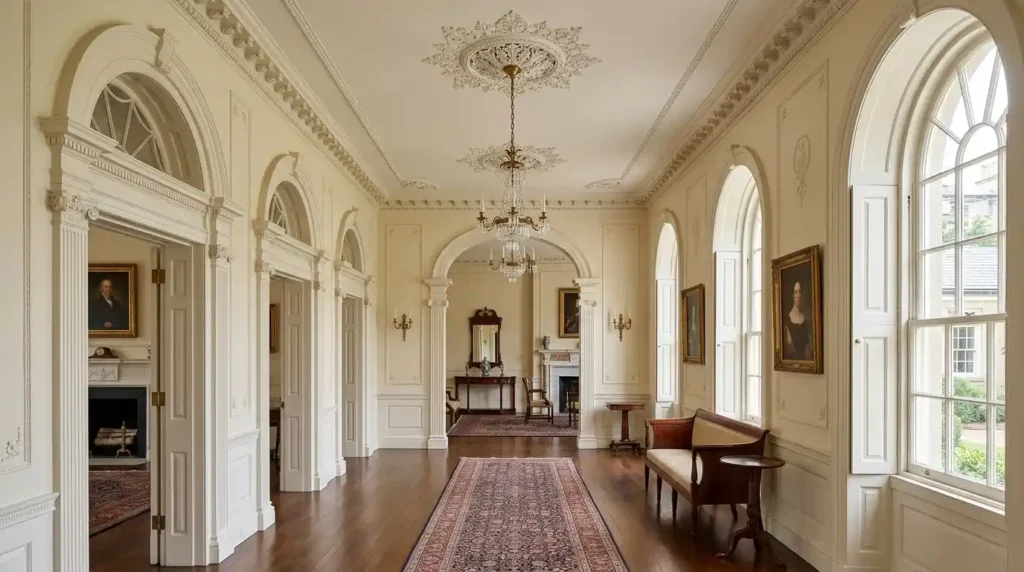
An example of a federal building is one that has brick exterior or clapboard siding, low roof, fanlights, sidelights, and possibly an ellipse window or Palladian window. Porticos, columns, pilasters, arches, pediments, domes, and balustrades are common features in the structure.
Ornamentation is restrained in federal architecture. Examples of ornaments include motifs, molding, cornice, frieze, tablet, swags, and urns. All enhancing the aesthetics but without overwhelming the building. The interiors feature such elements as ceiling medallions, fireplaces, and custom millwork. It is for this reason, among others, that federal architecture continues to be timeless. Each detail is not only visually pleasing but also functional.
Federal Architects and the Birth of Civic Architecture
The architects of the federal era were crucial to the creation of American public buildings. Standards set by them for governmental offices, courthouses, museums, post offices. And state capitols have been influential in the design of the buildings. Some examples of architecture of the time include the White House. The United States Capitol, and Monticello, which exemplified what was considered to be important to a nation through architecture.
Another vital aspect in creating great American architecture is urban planning. The layout of Washington, D.C. according to Pierre L’Enfant’s plans shows how architecture can be combined with urban planning to produce a well-planned environment. Planned broad avenues, monuments, and building locations make up a public place that is designed carefully.
Federal architecture would later influence cities such as Boston, Salem, and New York City, which still attracts architects, historians, and preservationists because of their historical architecture. Government and civic design remains one of the more distinct specializations within the profession today; Types of Architects covers how that specialization, and others, differ in practice.
Why Federal Architecture Continues to Influence Modern Design
Despite being formed hundreds of years ago, many of its concepts are still modern. In fact, architects still value the symmetrical nature of the style. Elements of federal style residences are often applied to today’s residential architecture, such as symmetrical façade, central entrance, cornices, and window sizes.
The example of federal revival style is an effective illustration of how the concept of architectural style can be brought to the present time. Construction in the style is based on the classical style yet meets all modern criteria.
Indeed, I have come across a tendency of people choosing traditional architecture because it provides stability and longevity. In contrast to the trends that become obsolete after a short period of time, federal architecture principles never lose popularity since they are based on the proportion and order.
Preservation, Restoration, and Adaptive Reuse
One of the key aspects that have emerged regarding federal architecture at present is that of preservation. Architecture that emphasizes historical preservation not only involves retaining building integrity but also adapting buildings to meet modern needs. Restoration architecture often entails a lot of craft, research, and drawings that guarantee authenticity.
Adaptive reuse has become quite prominent. Historical buildings ranging from government buildings to institutions as well as private dwellings are now being converted into museums, offices, education centers, and residential spaces. However, the task is not always straightforward. Architects working on preservation need to take into account the aspect of materiality as well as that of landscape design, energy efficiency, accessibility considerations, and planning guidelines.
It is due to this reason that federal architecture is highly successful when it comes to adaptive reuse projects.
The Relationship Between Federal Architecture and Sustainability
While sustainability seems like an innovative approach for the contemporary period, the majority of federal buildings demonstrate elements that enable sustainable performance in the future. Thanks to the strong materials and high quality of construction work, the buildings constructed over two centuries ago still function successfully. The longevity of the buildings can be regarded as an example of sustainable development in architecture.
The preservation of historic buildings helps decrease waste and enables longer life spans. This approach prevents unnecessary production of building materials needed for constructing buildings anew. Landscape integration also plays a crucial role in achieving sustainable performance. Federal buildings are usually placed within specially created landscapes.
As urban sustainability becomes more significant, there are valuable examples to be learned from federal architecture.
The Lasting Influence of Federal Architects on Public Architecture
The challenge faced by public architecture is meeting the needs of the community while at the same time embodying the ideals of the community. Federal architecture was adept in addressing this challenge. It shows that there is no need for grandeur in monument architecture; rather, monument architecture requires proportion, symbolic meaning, and craftsmanship.
The John F. Kennedy Federal Building and Chicago Federal Center show that even as public architecture continues to evolve, there is still relevance of good federal architecture design. Government architecture succeeds when it is clear, accessible, and durable.
The best legacy left behind by federal architects is that buildings should be timeless. Architectures that strike the right balance between form, structure, and function are those that stand the test of time.
The Lasting Value of Federal Architectural Thinking
However, federal architects did much more than merely designing beautiful structures for the government. They created a unique style of design that is based on proportion, skillful craftsmanship, and its role in society. Even today, their influence can be seen in such modern structures and historical restorations as American federal structures of the past and the present. One can safely say that such architectural masterpieces were not created by chance but rather through diligent planning and the use of quality materials.
Conclusion
The architects of federal architecture did not just invent one unique style; they devised an entire approach through which public architecture could convey its character, order, and importance. Their focus on proportion, simplicity, and longevity still serves as a guideline in the design and preservation of structures. Even at present, their work is evident in the designs of buildings that have been influenced by federal architecture through their harmonious nature rather than extravagance. In essence, the reason why federal architecture remains influential is that it proves that architecture will last forever when there is clarity, balance, and respect for form.
Frequently Asked Questions (FAQ’s)
Federal architecture is an American architectural style that developed after independence, mainly between 1780 and 1830. It is known for symmetry, balanced proportions, restrained ornament, classical details, and carefully organized façades.
Original Federal architecture belongs to the late 18th and early 19th centuries, while Federal Revival adapts its symmetry, classical details, and proportions for later buildings. The revival approach keeps the traditional character while accommodating modern construction needs.
Look for a balanced façade, central entrance, brick or clapboard exterior, fanlights, sidelights, low rooflines, and restrained classical details. Palladian windows, columns, cornices, pediments, and decorative molding may also appear.
Federal architects helped establish the visual language of courthouses, government buildings, capitols, and other public spaces. Their emphasis on order, proportion, durability, and symbolism influenced how American civic architecture developed.
Adaptive reuse makes sense when a historic structure can serve a new purpose without losing its important architectural character. Successful projects preserve significant materials and details while addressing accessibility, energy efficiency, and modern functional needs.

2 thoughts on “Federal Architects: Why Their Buildings Still Define Public Architecture and Timeless Design”