
I have walked the stretches of Route 6A in Yarmouth Port more times than I can count. Every time, the sight of a full Cape standing quietly along that historic road still stops me. There is something deeply satisfying about a house that makes no promises it cannot keep. The Cape Cod house is that kind of architecture honest, functional, and beautiful in its restraint. Standing at the corner of simplicity and timelessness, this quintessential New England home style has endured for over three centuries.
The Cape Cod house is one of the most recognizable architectural styles across the country today. It originated in the Massachusetts coastal region, shaped by the demands of a bitter New England climate. Early settlers from Britain adapted the English half-timber hall and parlor house into something boxier and lower-slung. That silhouette stood up far better against stormy weather and heavy snow accumulations than any earlier design had managed.
What Exactly Makes a Cape a Cape?
Gary Sachau, an architectural historian who retired from the National Park Service, said succinctly during a stroll around Yarmouth Port. Most important part of any Cape Cod house, he said, is that it is 1 ½ stories tall with the gables sloping front to back. Your first impression at the road ahead is a steep-pitched unadorned gable roof.
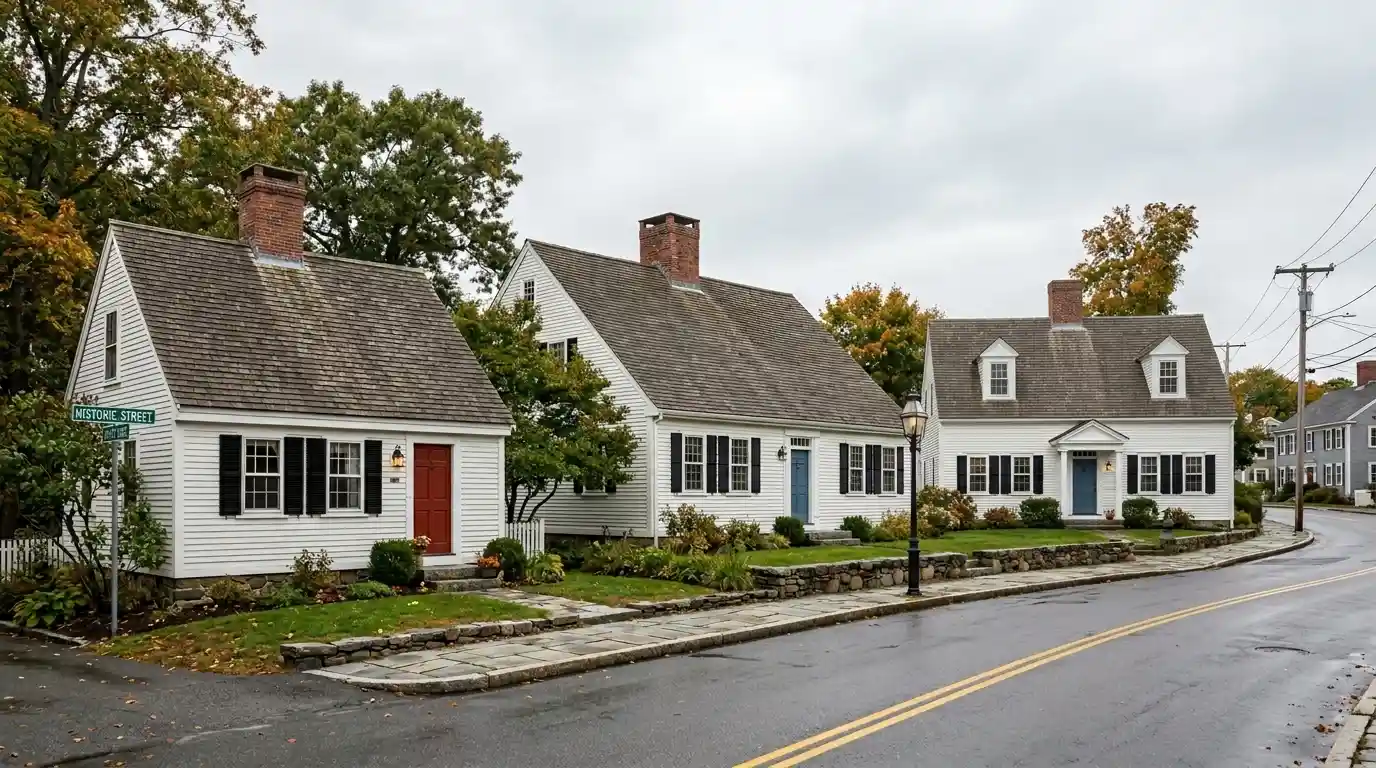
An average antique Cape features a central chimney located to provide warmth to all rooms through the center of the house. With a full Cape, the center door is at the front of the house, with the two windows positioned symmetrically of the center door. The half Cape can look like one side has been lopped off right next to the door. A three-quarter Cape sits somewhere in between these two well-known forms. On a short stretch of road in Yarmouth, you can find full, half, and three-quarter Capes all standing together as historic neighbors.
The basic rectangular shape of these homes is immediately readable from any angle or distance. Low ceilings helped conserve heat during the long, cold months of January and February. The biggest windows always faced south to catch the winter sun and pull warmth into the home. Shutter-clad windows and dormer windows added both protection and light to these modest but practical dwellings.
The Origins: Settlers, Climate, and Necessity
Early settlers of America constructed the first Cape Cod houses in the 1600s and continued building them at a steady pace until 1850. Bitterly cold New England winters forced the English colonists to modify their preferred hall and parlor plan. The architectural design was inspired by Britain, and is entirely adapted from necessity, rather than art. January and February temperatures will be around −10°F (−20°C) and thoughtful design becomes a matter of life and death.
The central chimney was not designed for aesthetics, but rather as the hub of the home’s heating system. The colonists constructed great chimneys where fireplaces could be put on either side of it. The steep roofs were covered with cedar shingles which quickly and efficiently shed heavy snow accumulations. Colonists also shut windows with shutters as the weather turned strong in the summer when it would push temperatures up to 90°F or 30°C.
The term “Cape Cod House” was coined by Reverend Timothy Dwight IV, the 8th President of Yale University (1795-1817), who visited Cape in 1800. His writings, which he published posthumously in “Travels in New England and New York” (1821-1822), praised these homes as “inferior” but the term has become permanent. From then on, the small houses with their pitched roofs were referred to as “Cape Cods” throughout New England and beyond.
Four Types: Quarter, Half, Three-Quarter, and Full
The first Cape Cod houses fell into four distinct categories based on size and footprint. The comparatively rare quarter Cape consisted of a single bay with one door and one window across the front facade. The half Cape featured two bays, with a door to one side and two windows positioned on one side of the door. The three-quarter Cape added a single window on the opposite side of the door for better light and symmetry.
The full Cape is generally regarded as the best expression of the style of architecture and the most satisfying. It has a central door with side double windows to make a perfect symmetrical rectangular façade. Within the front door, there was a small upper level above with a central staircase. The second floor usually had two children’s rooms; their primary bedroom and parlor were usually on the first floor.
A lot of times, as architectural historian Gary Sachau described it during our walk in Yarmouth Port, a house would begin as a half Cape for cost considerations. The family increased and the success of the endeavor made it possible for the addition of bays and windows to the right or left as necessary. This flexibility, adaptability, and quality is what makes the Cape Cod design so enduringly so practical for generations of New England families and settlers.
Materials Built for Survival
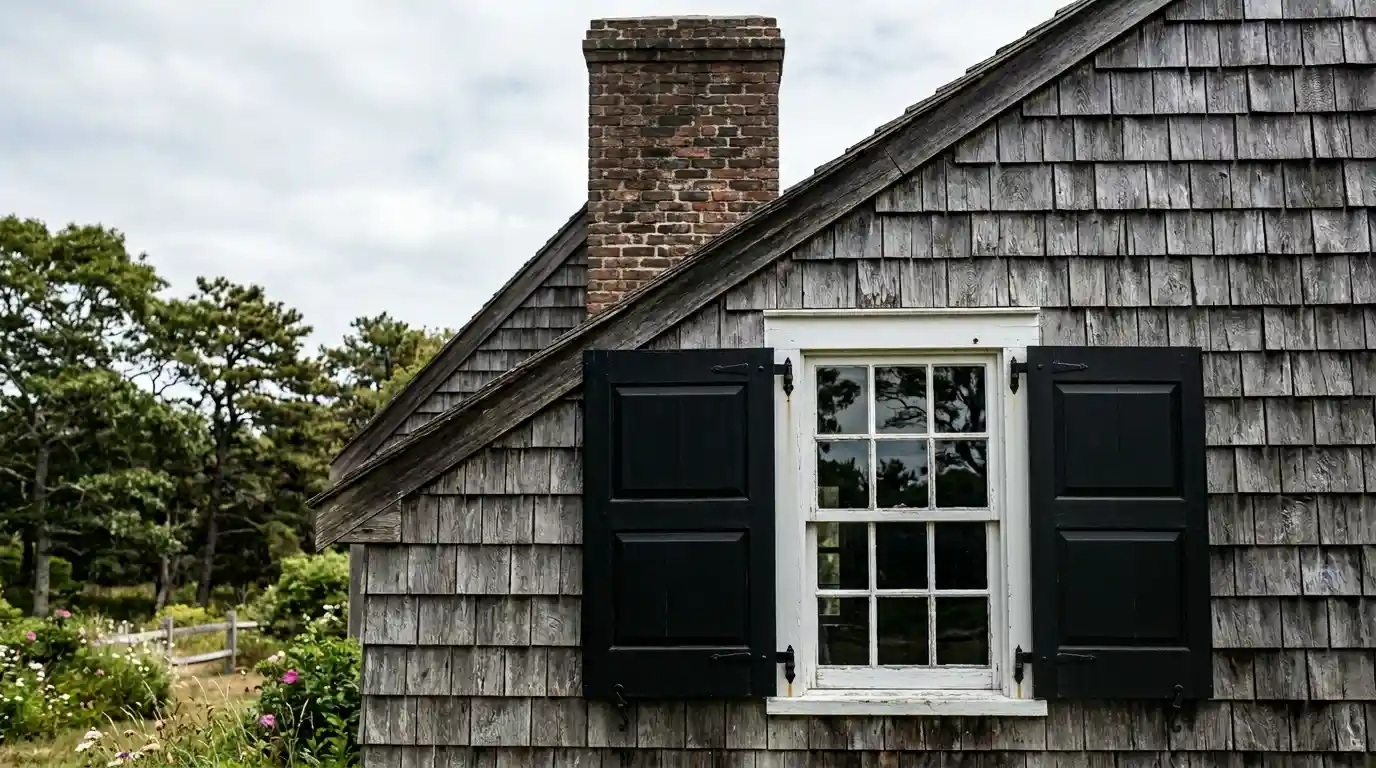
Hardy local materials were used to build the traditional Cape Cod houses, which were designed to stand up to the toughest of New England winters. The structure was made of oak and pine, and the interior rooms were floored with oak and pine. The central chimney was supported by brick fireplaces and the exterior walls were covered with clapboard and cedar shake roofing and side shingles.
Those cedar shingles were deliberately left unpainted and exposed to the elements and weathering to develop a familiar grey. The shaggy grey siding grew into one of the most recognizable siding features of the original Cape Cod cottages on the Massachusetts coast. Some exteriors were painted classic white with sturdy black wooden shutters framing each multipaned window across the symmetrical facade.
Shiplap was a typical exterior siding style used widely for Cape Cod homes throughout New England and beyond. This wood planking looked like ship siding, which made perfect sense given the nautical feel of coastal communities where these homes were first built. When painted or stained, traditional Cape Cod homes appeared in blue-gray, gray, brown, beige, or white tones across their exterior walls. Oak and pine solid wood pieces gave interiors a warm and rustic feel that matched the modest charm outside.
The Cape Cod Revival: From Depression to Suburb
The Cape Cod style enjoyed a remarkable renaissance beginning in the 1920s and peaking through the 1930s to the 1950s The popularity of the Cape Cod home was renewed during The Depression of the 1930s due to its very economical design and low cost of construction. Following World War II, returning soldiers were in need of housing quickly, and the Cape Cod design started to be the solution to the post-war housing boom in the 1940’s and 1950’s.
In 1925, Royal Barry Wills established his architectural practice in Boston, and by 1940, he was referred to as the master of Cape Cod architecture. His work extended from the 1920’s through the 1960’s when he designed about 2500 single family houses throughout New England and beyond. He also wrote eight books, hosted a radio program, and gave many lectures that helped spread the Cape Cod Revival across the middle class.
The post-World War II suburbs were born in Levittown, Long Island, New York, in the country’s first planned community of identical rows of Cape Cod cottages. Those cottages were built to cater to returning military veterans who needed affordable, functional housing quickly. Cape Cod Revival houses from that mid-20th century period were often more embellished than the earlier, more austere colonial-era Cape Cod homes.
Arthur P. Richmond published a book in 2011 titled “The Evolution of the Cape Cod House: An Architectural History” documenting this lineage. It showed how the clean lines of a Cape Cod echo medieval English cottages in their proportions and simplicity. Vincent House in Edgartown, owned by the Vineyard Preservation Trust, was built in 1672 and predates the Declaration of Independence.
Living Examples across New England
Dozens of surviving Cape houses have been documented in Massachusetts, Connecticut, Rhode Island, Vermont, Maine, and New Hampshire as part of the Buildings of New England project. The Gardner-Borden House, constructed c. 1795 in Swansea, Massachusetts, was originally a five-bay, center-entrance Federal cape house that was later added onto. Rare example of a half-cape dwelling lovingly preserved by generations of private stewards, is the Follett House on Chestnut Street in Wrentham, built circa 1820.
One of the most historic of the unaltered residences in Wrentham is the Ebenezer Fisher House built circa 1764. The Boyden-Clark House was constructed near the Rhode Island state line around 1725 and still has its hallmarks of the Colonial era – the gambrel roof and central chimney. The Cranston Cottage, constructed about 1766 in Warren, Rhode Island, demonstrates the number of early New England residences that were constructed at first, but then expanded as families grew.
The Samuel J. Nutter House (c. 1750) on Indian Pond Road in Kingston, Massachusetts is a rare example of a half-cape Georgian-era house. The Dillingham House is a typical Greek Revival 1840s central portico on Ionic columns on Pascal Avenue in Rockport, Maine. The Harkness House is a beautiful Georgian-style, one-and-a-half story, squat gambrel roof house built about 1730 in Newport, RI. Constructed between 1680 and 1740, the Killicut House in Nashua, NH is one of the few remaining 18th-century houses in the city.
Exterior Colors, Siding Profiles, and Modern Interpretations
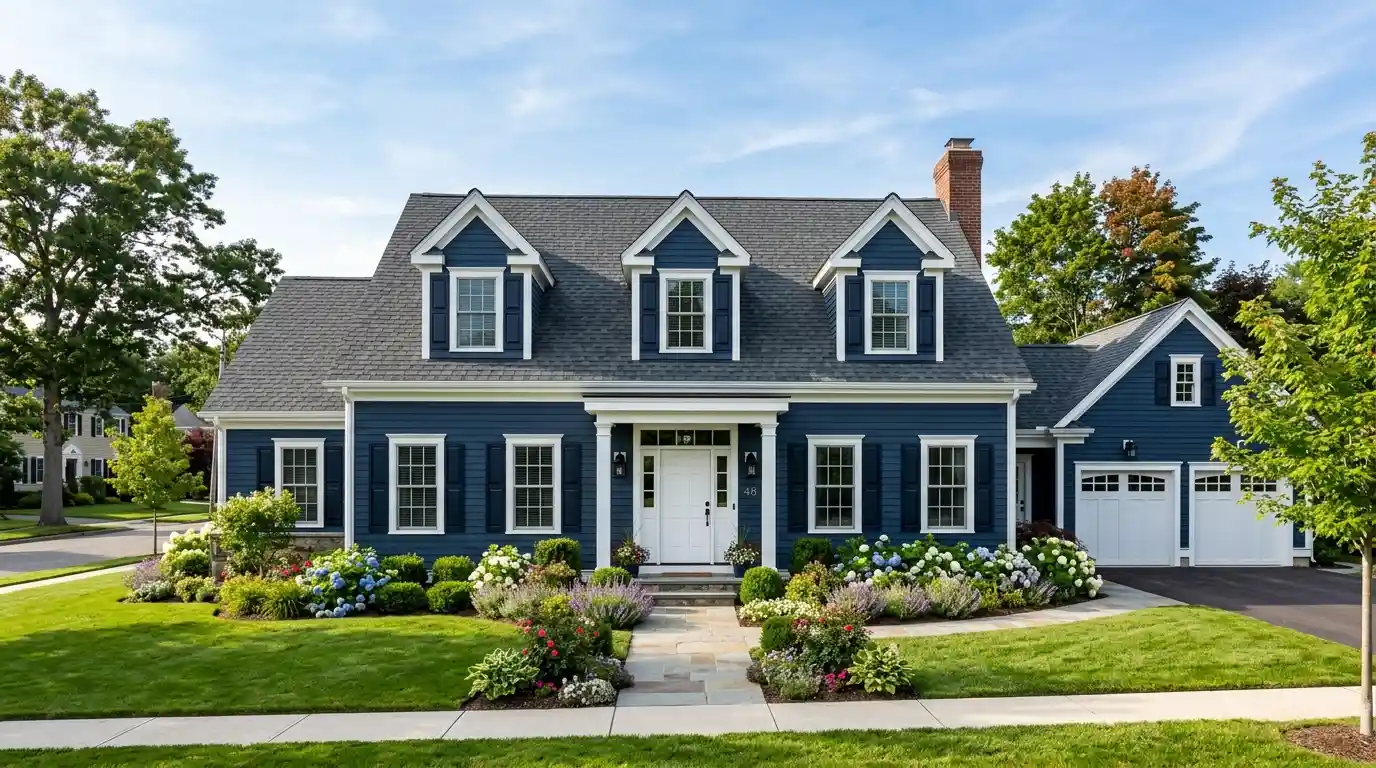
On a windy Cape Cod coastline, and in a cottage style landscape, the traditional Cape Cod house is traditionally clad in natural colors. The Cape Cod exterior palette is made up of muted blues and grays, warm yellows, reddish browns and buttery beige. Once more, Trim was historically white, and exhibits the simplicity inherent in this architectural genre from the earliest colonial period. The new colors are sage green and aquamarine, which are inspired by the sea and evoke a sense of coastal New England.
Today, the Cape Cod is a home type that lets house owners go heavy on the blue, green, and oddball trim colors on the front facade. Combination siding profiles (e.g. lap siding/shingle siding in different areas) can provide variety and a touch of individuality. The shingle shake exterior profile is still a classic, and gives the building a rustic and charming appearance that is a perfect continuation of the cedar shake tradition of the original cottages. Each of these styles of lap siding—plank lap, board-and-batten, and staggered edge panels is a subtle variant on the classic Cape Cod exterior.
Today, some homeowners are even removing shutters altogether, with a focus on making the trim work stand out for a more subdued, understated aesthetic. A darker, or even matching, trim can help create a traditional but contemporary look for a Cape Cod home that is fresh but still retains its historic character. Dormer windows popularized in the early 20th century to provide more light and ventilation to upper bedrooms, were very much a later addition to the cape cod style home, rather than something that was found or used on many Cape Cod homes.
Interiors: Cottage Charm Meets Coastal Life
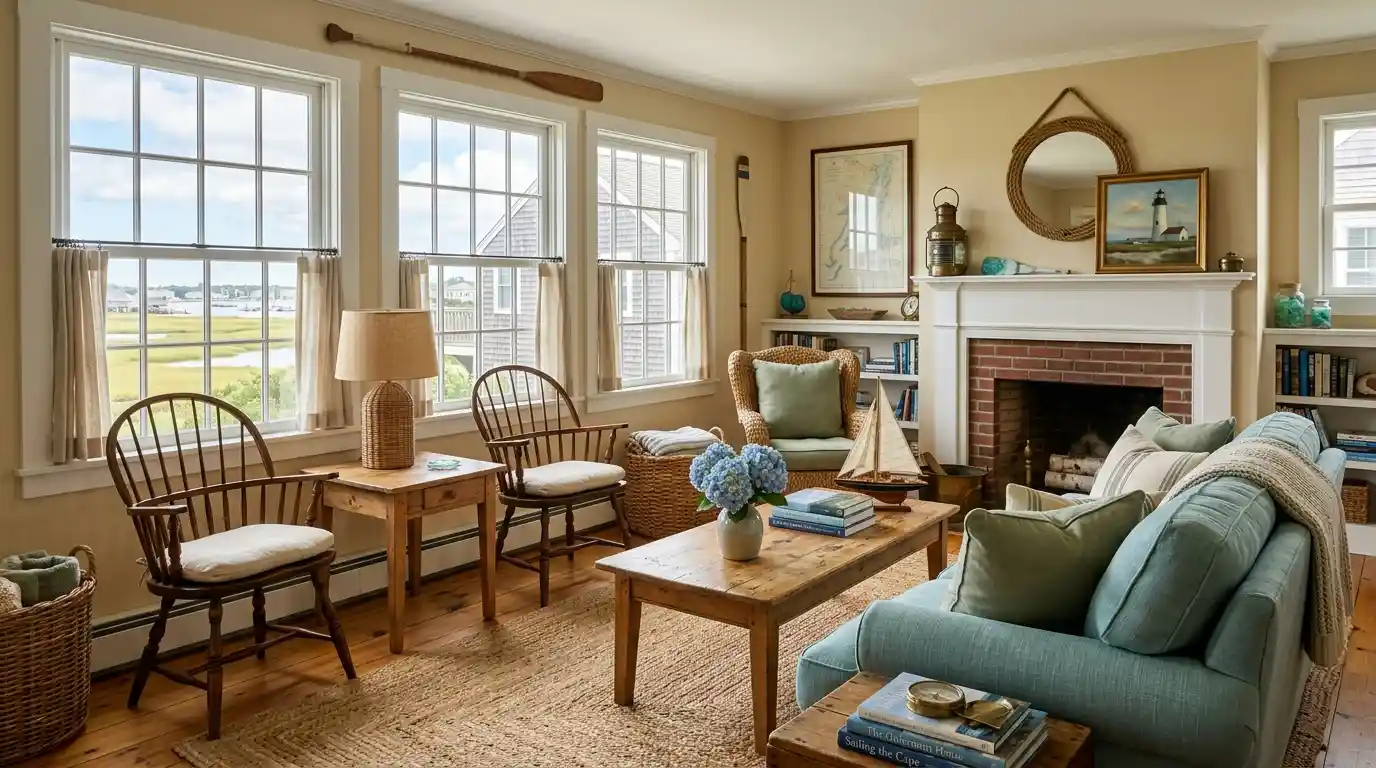
Interiors are furnished with items that have clean lines and traditional styling, and simple, minimalist forms that draw on traditional cottage charm on Cape Cod. Sitting areas are usually soft, featuring deep-buttoned cushions, and solid wood pine or oak furniture provides a cosily rustic ambiance to each room. Throughout New England historically accurate Cape Cod interiors abound with early American handmade furniture, ladder back chairs, and wicker furniture.
Nautical and coastal accents refer to the windswept seashores where life for the shipmen and mariners that built these homes. These ocean-inspired homes are greyed out with shades such as sage green, aquamarine and buttery beige, creating a natural, relaxing beach vibe. The original interior design included only two rooms: a hall (living) and a parlor (main bedroom) which resemble the interior design of hall and parlor English houses.
Conclusion
The honest bones of the new Cape Cod houses being erected today are the same as their colonial ancestors three hundred years ago. The steep pitched roof, the central chimney, the symmetrical facade, and the rectangular shape are as easily identifiable and comforting as ever. The difference now is that homeowners can now add their own flair to these homes while not altering their core. Larger windows, open floor plans, bold exterior colors, and modern siding profiles have found their way into new Cape Cod houses without diminishing the style.
The dormer windows, the cedar shake texture, the cottage-like landscaping all of it still feels rooted and right. New Cape Cod houses continue to appear across New England and well beyond the Massachusetts coastline where it all began. They show up in suburbs, in rural communities, along windswept seashores, and on quiet residential streets across the entire country. What makes them endure is not nostalgia alone it is the fact that a well-proportioned, simple, functional home never really goes out of style. New Cape Cod houses are proof that the best architectural ideas do not age they just keep finding new families to shelter.
Frequently Asked Questions (FAQ’s)
A Cape Cod house is a simple, rectangular, usually one-and-a-half-story home known for its steep roof, symmetrical façade, central chimney, and practical New England design.
A full Cape typically has a centered front door with matching windows on both sides, creating a symmetrical façade. A half Cape is smaller, with the entrance positioned toward one side and windows grouped beside it.
These features developed in response to harsh New England winters. The steep roof helped shed heavy snow, while the central chimney distributed fireplace heat efficiently through the compact interior.
Traditional Cape Cod houses commonly use oak or pine framing, cedar shingles, clapboard siding, brick fireplaces, and natural wood interiors. Unpainted cedar often weathers into the familiar gray finish associated with coastal Cape homes.
The best approach is usually to preserve recognizable Cape Cod features such as the simple rectangular form and pitched roof while adapting elements like windows, siding, layouts, and exterior colors for modern living.

7 thoughts on “New England Cape Cod Houses: History, Style & Timeless Design Features”