
Few homeowners undertaking a whole home renovation begin with a plan. They begin with one room. Maybe the kitchen that they have been unhappy about for years. Or the bathroom with fixtures dating back to the 1980s. And before long, they realize that working on one thing just uncovers the next issue that needs fixing. The electrical panel is not big enough for the new kitchen design. There is cast iron plumbing behind the walls of the bathroom. The insulation, revealed once the dry wall is stripped away, is either insufficient. Or even asbestos if the house is older than 1980. What began as a kitchen renovation has now turned into a gut job. That cost $150,000 instead of the original $40,000 budgeted.
As someone who has gone through the process of working with budgeting for renovations with many different homeowners. I have realized that those individuals. Who manage to complete their home renovations within budget. And timeline have one thing in common they did not ask tough questions. Until after they picked up a hammer but rather before.
What a Whole Home Renovation Actually Includes
Home renovation is different from a cosmetic renovation. And this difference is important because the cost between the two renovations is quite large. And misunderstanding the two concepts is how homeowners get stuck mid renovation. When they do not have enough money to go through with it.
Cosmetic Renovation
Cosmetic renovation consists of painting the interiors, replacing the flooring, replacing the fixtures. And refreshing the kitchen and bathroom, and this renovation costs about $50,000 to $90,000. Depending on the size of the house. Which in this case is around 1,500 square feet. And this type of renovation has no structural modifications nor any systems work except the fixtures.Fresh paint is one of the most cost-effective ways to transform a home during a cosmetic renovation. If you’re choosing a timeless dark neutral for cabinetry, trim, or accent walls, our guide to Tricorn Black by KD Architects explores where this popular color works best and how to pair it with different interior styles.
Full Gut Renovation
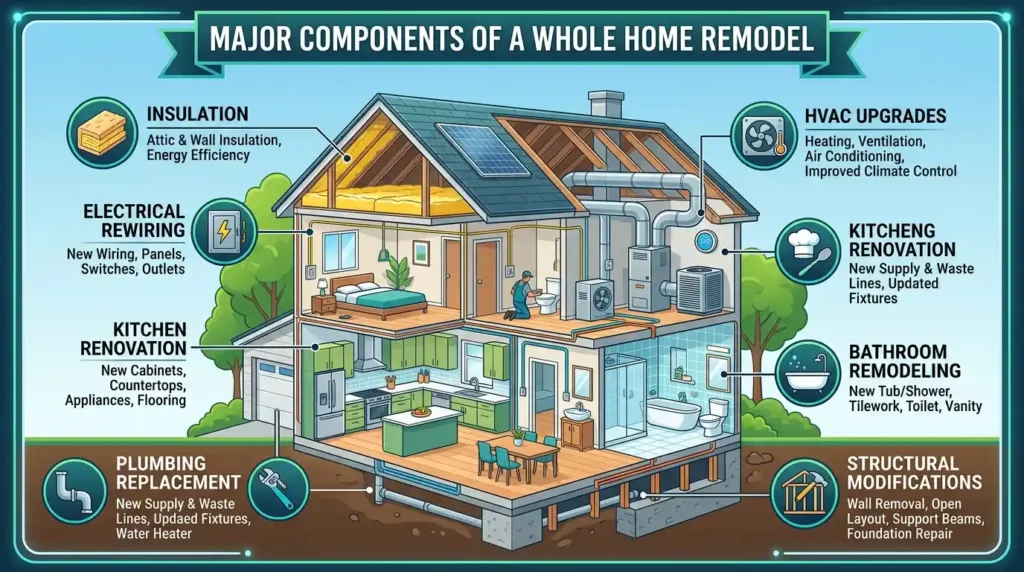
A full gut renovation goes considerably further. It involves structural modifications, load bearing wall removal, floor plan alteration, room reconfiguration, electrical rewiring, full repipe, HVAC system upgrade, insulation replacement, foundation repair. Where needed, and often attic conversion or basement finishing to add functional square footage without expanding the home’s footprint. This level of complete home renovation for a 1,250 to 1,600 square foot home runs $150,000 to $300,000. According to 2026 Angi data, with the national average for whole house renovation. Across that size range landing at $52,275 a number. That Inspiration Homes correctly flags as nearly useless on its own. Because it represents a midpoint between very different projects rather than a realistic budget for a specific scope.
Useful Framework
The more useful framework is the one that experienced general contractors use in practice: are you refreshing surfaces, or are you opening walls? If surfaces, your budget falls in the $50,000 to $90,000 range. If walls are opening systems are being replaced, layout is changing, structural modifications are happening the floor plan alteration budget starts at $350 to $500 for minor changes and exceeds $10,000 for major reconfiguration involving steel I-beam installation after load-bearing wall removal. Whole home remodels at this scale for a 2,000 square foot home run $100,000 to $200,000 nationally, and $150,000 to $400,000 in higher-cost markets like Pennsylvania and New Jersey, with Bergen County NJ tracking approximately 1.20x the national average, Bucks County at 1.05x, and Lehigh Valley running closer to 0.95x.
The Hidden Cost Layer That Derails Pre-1980 Homes
However, old home renovation requires a separate discussion since the cost multipliers that affect pre-1980 house renovation take all first time home renovators by surprise every time. Budget additional 15 percent for any unexpected electrical and plumbing work which would violate the modern day building codes once the walls were open. Electrical panel upgrade costing between $1,400 and $2,800 is often required to connect a newly installed kitchen complete with various types of smart appliances to electricity in houses that were constructed before 1980. Outdated wiring, lead paint hidden behind newer layers of paint, asbestos in the insulation and original cast iron plumbing are routine discoveries made while doing home renovation in houses constructed prior to 1980. Damage from termites and basement water damage becomes evident during demolition stage of older home renovation.Older homes frequently require plumbing upgrades once walls are opened, making it an ideal time to improve the home’s water infrastructure as well. Our guide on Whole House Water Filtration explains how modern filtration systems can be incorporated during renovation instead of becoming a separate project later.
Contingency Budget
This is also why the contingency budget conversation is non-negotiable. Most renovation guides recommend 10 to 15 percent contingency for newer homes. For older homes, 15 to 20 percent is the floor, and 20 to 30 percent is genuinely prudent. Across all whole home renovations, homeowners underestimate project expenses by 20 to 40 percent on average a gap that comes not from contractor dishonesty but from the genuine impossibility of knowing what’s behind walls until demolition reveals it. The contingency fund is what keeps a whole house renovation from stalling at the worst possible moment, when systems are exposed and the home is temporarily uninhabitable.
Temporary Accommodation Cost
The temporary accommodation cost during a complete home renovation adds $2,000 to $10,000 to the total project budget depending on duration, and it’s a line item that surprises homeowners who assumed they’d live through the project. Mechanical upgrades are often completed at the same time as a full renovation because walls and ceilings are already open for construction. If you’re replacing an aging HVAC system, our guide on Ductless Heat Pump for Your Home explains when a ductless system makes sense, how it affects energy efficiency, and what homeowners should consider before installation.
When the kitchen, bathrooms, and HVAC are out of commission simultaneously, the realistic option is temporary accommodation an extended stay hotel or a mobile home on property for larger projects and that cost belongs in the planning budget from week one, not as a reactive expense discovered mid-construction.
Room by Room Costs for Whole Home Renovation in 2026
Kitchen remodel is the most significant expense component in a comprehensive home remodel. A typical kitchen full remodel costs between $14,585 and $41,530 nationally and between $25,000 and $60,000 mid-range in Pennsylvania and $40,000 and $70,000 in North Jersey. An all-out kitchen remodel anywhere in an expensive area can easily cost between $60,000 and $120,000 and up for custom cabinets, quartz countertop, quality appliances, and remodeling layout. According to Jim Cory, Senior Editor at Remodeling Magazine, “a kitchen can get $20,000 worth of remodeling done wisely with impressive visual impact” although “diminishing returns set in quickly past $50,000 invested in a kitchen, AmeriSave’s 2026 home remodeling costs estimate”. In conclusion, it pays off to use mid-range stock cabinets and quartz countertops, cafe appliances, and LVP flooring rather than custom cabinets and imported appliances for resale purposes.
Bathroom Remodeling Project
For a standard bathroom remodeling project, the average price per bathroom ranges from $15,000 to $35,000, for a mid-range project from $30,000 to $50,000 in Bergen County, and for a luxury bathroom suite from $55,000 to $80,000. According to This Old House Bath 2026 Survey, 67 percent of the bathroom remodeling project includes plumbing services, 53 percent – tile installation services, 45 percent – the installation of showers or bathtubs, and 42 percent – electrical services; therefore, limiting the bathroom renovation scope to these basic components will guarantee maximizing the return of investment (ROI) of 55 to 75 percent.
Basement Finishing Costs
The Basement finishing costs $15,000 to $45,000 on average in 2026, with basic basement finishing at $15 to $30 per square foot covering framing interior walls, basic electrical and lighting, drywall installation, carpet or laminate flooring, and simple drop ceiling installation. Basement renovation that converts raw storage space into functional living area effectively adds square footage without expanding the home’s footprint which makes it one of the more capital efficient choices in a whole home renovation scope.
Bedroom Renovation
Bedroom renovation without structural changes runs $4,000 to $12,000, living room renovation covering flooring, paint, and lighting runs $5,000 to $10,000, and home office conversion starts at $5,000 to $10,000 for a basic home office conversion, rising to $10,000 to $18,000 for a professional home office and $20,000 to $40,000 for a full home office addition. The remote work influence on renovation priorities has been consistent through 2025 and into 2026 – 23 percent of the US workforce was working from home as of late 2025, making dedicated office space one of the more reliable value-add upgrades in current buyer preference data.
How to Hire the Right Contractor for a Whole Home Remodel
The selection of who to employ in a whole house renovation is possibly the most important decision you have to make in the entire process. The design-build company unites all your needs under one roof as far as architects, designers, and construction firms are concerned; this avoids the problem of poor coordination in case you employ three different firms because none of them will take the blame when there are problems arising. This added value in the process justifies why you pay extra compared to the lowest bidder general contractor option.Choosing a renovation team is about more than comparing prices—it also means understanding how architects, designers, and contractors collaborate throughout the project. Our article on WW KDArchitects explains how an integrated design process helps reduce communication issues while improving planning, budgeting, and construction quality.
Contractor Bid Process
The contractor bid process requires at least three different bids with itemized line-item prices for their estimates. Itemized line-item pricing provides an estimate of labor costs versus material costs versus permit costs versus contingency allowances and helps you understand precisely what you are paying for as opposed to reacting only to the total price. Warning signs while evaluating a contractor include hasty signing of a contract before design finalization, poor communication during pre-project phase, inability to produce references for similar projects as yours and lack of license and insurance certificates.
Ask your past customers about project timelines, budget overruns and how the contractor dealt with issues that occurred in the middle of the project this way, you will learn almost everything about how your relationship will be like in case something unexpected happens after the demolition begins. BBB search, credentials confirmation and phone call to at least two to three references are basic due diligence measures before signing a contract.
Financing a Whole Home Renovation and Maximizing ROI
HELOC and home equity loans account for 54% of funding methods utilized to renovate houses in 2026. At the moment, home equity loan interest rates range between 8% and 9%, whereas those of personal loans stand at 7% to 12%. Cash-out refinance is reasonable if the existing mortgage rate competes well with the new refinancing rate, something that should be verified with the help of a lender in 2026 where the interest rates are higher. Fannie Mae HomeStyle loan combines renovation expenses into one conventional loan but requires plans by the contractor prior to closing. Finally, FHA 203(k) renovation loan is for buyers who purchase fixer-upper and need to fund purchase and renovation at once.
Helpful Benchmark
As far as remodeling goes, one can use a helpful benchmark the 30 percent rule. You have to refrain from spending more than 30 percent of your house’s present-day value to ensure financial feasibility and prevent yourself from being priced higher than other properties on the market. As Israel Ramos, a real estate agent from Phoenix, Arizona, notes, you must not exceed the ceiling price in your neighborhood if you want to recover your money.
ROI, Exterior Improvements Lead In 2026
For pure ROI, exterior improvements lead in 2026: garage door replacement delivers 268 percent ROI, entry door updates return 216 percent, and new siding returns 208 percent. Among interior projects, minor kitchen remodels recover approximately 96 percent of costs, deck additions return 95 percent, and mid range bathroom remodels return 70 percent. Major renovations like primary suite additions and luxury high end home overhauls deliver only 24 to 36 percent ROI making them personal enjoyment investments rather than resale value drivers. Energy efficiency upgrades window replacement, insulation, HVAC replacement may qualify for government renovation incentives, energy efficiency tax credits, rebate programs, and grant funding that meaningfully offset upfront costs. The $526 billion projected US renovation spending by early 2026, according to the Joint Center for Housing Studies, confirms that whole home renovations remain the primary vehicle through which American homeowners protect and grow the value of their largest single investment.
Conclusion
The success of an entire house renovation depends on the homeowner’s approach to proper planning, equal in importance to construction. Decisions on defining the scope beforehand, planning the budget based on the realism of contingency for surprises, which older homes tend to keep hidden behind the walls, scheduling room renovation to limit the impact on existing systems to one time, and finding a contractor whose references can be reached will play a greater role than each individual choice. National average cost of $52,275 serves as a point of discussion, not a budget. Whether you are going to refresh or reveal lies under the walls, that is what it will all depend on, and the earlier you figure it out, the better everything will go.
Frequently Asked Questions (FAQ’s)
A whole home renovation can include layout changes, structural work, electrical and plumbing upgrades, HVAC improvements, insulation, and remodeling major rooms such as kitchens and bathrooms. The exact scope depends on whether the project is mainly cosmetic or involves opening walls and replacing major systems.
A cosmetic renovation focuses on visible updates such as paint, flooring, fixtures, kitchens, and bathrooms without major structural work. A full gut renovation goes deeper, often involving structural changes, rewiring, repiping, HVAC upgrades, and floor-plan modifications.
A contingency of around 10–15% may be suitable for newer homes, while older properties can require 20–30% because hidden plumbing, electrical, water, or structural problems are more likely to appear after demolition begins.
Compare at least three detailed bids and check each contractor’s license, insurance, references, communication, and experience with similar renovations. Itemized estimates are especially useful because they show how much is allocated to labor, materials, permits, and allowances.
It can be worthwhile when the renovation improves function, resolves outdated systems, and keeps spending reasonable compared with the home’s market value. However, smaller kitchen, bathroom, and exterior improvements may deliver stronger resale returns than large luxury renovations.

3 thoughts on “Whole Home Renovations: Costs, Planning Tips, and the Right Remodel Sequence for 2026”