
Here’s the thing nobody tells you upfront a kitchen renovation can go perfectly on paper and feel completely wrong once you’re actually living in it. I’ve walked through finished remodels that cost $40,000 and made me wonder what happened. Cabinets gorgeous. Countertops flawless. The person standing at the stove couldn’t reach the prep sink without turning sideways. That’s a layout problem, and no amount of Calacatta gold quartz fixes a layout problem.
So before anything before cabinet samples, before you go down a backsplash rabbit hole, before you even touch a kitchen remodel cost calculator the kitchen floor plan needs to be right. The cooking zone, prep zone, and cleaning zone have to talk to each other. That relationship, which designers call the work triangle, is what separates a kitchen that works from one that just photographs well. Open concept kitchen layouts dissolve the wall between kitchen and living or dining space that change alone solves both natural light and the feeling of being shut away while everyone else is in the next room.
Galley kitchens, for all the times they’ve been dismissed as a compromise, are genuinely the most efficient kitchen layout for serious cooking. Everything within arm’s reach. No wasted steps. Urban homes and smaller flats across the UK and Europe have been leaning back into galley kitchen design hard, and it makes complete sense. L-shaped and U-shaped kitchen configurations work well when the footprint allows they give you room for a kitchen island without the whole space feeling like an obstacle course.
The Cabinet Decision Everything Else Gets Priced Around
Cabinets will eat 25 to 35 percent of whatever you’ve budgeted. That’s the consistent reality across kitchen renovation projects of almost any scale. Stock cabinets start around $5,000. Custom cabinetry can push $36,000 or well past it. For most people, semi-custom is the honest answer better proportions than stock, far less than full custom, and enough flexibility to actually suit the space.
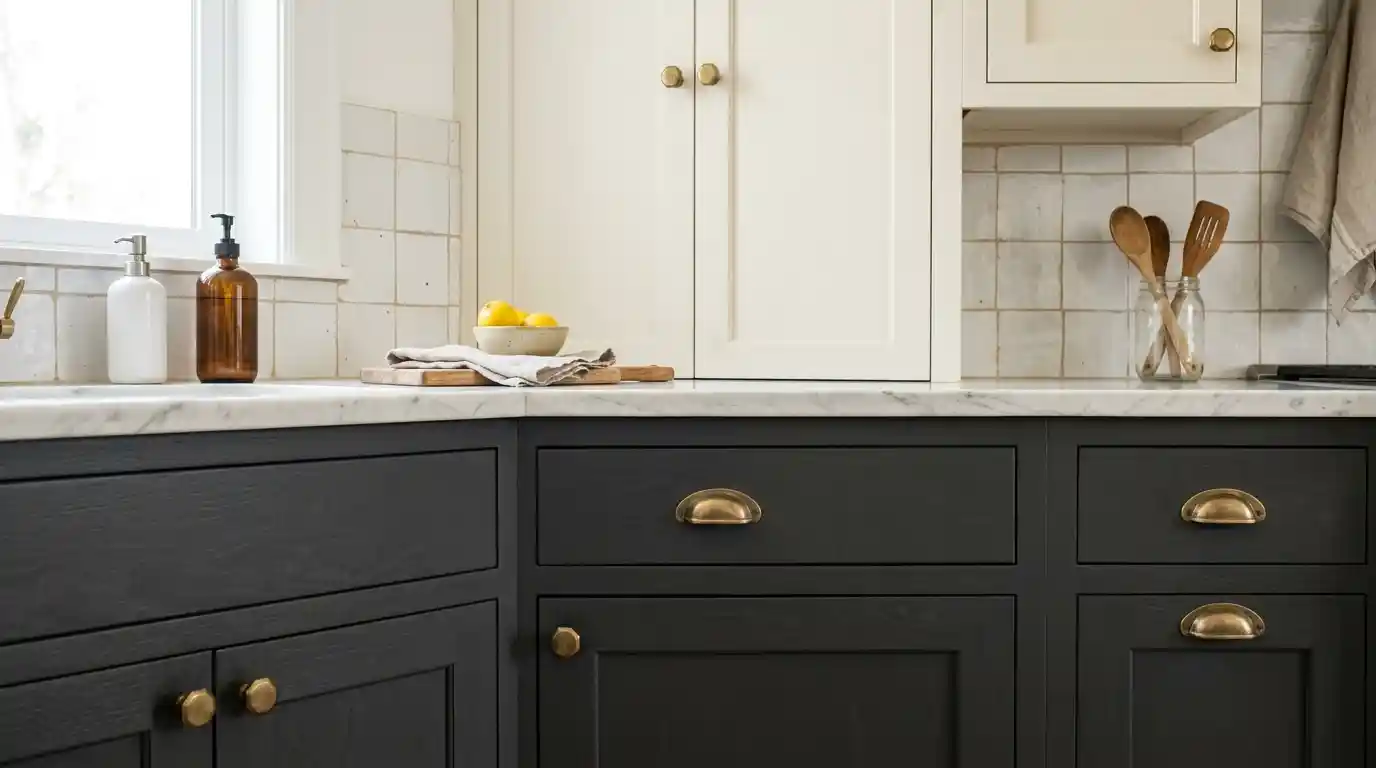
What matters more than the cabinet finish is the configuration. Floor-to-ceiling cabinets are worth it every single time, not because they look dramatic though they do but because that gap above standard upper cabinets just collects grease and dust and serves no function. Handleless cabinets read cleaner. Two-tone cabinets have genuinely taken over from the all-white kitchen in terms of what designers are actually specifying navy blue lowers with warm white uppers, charcoal gray base units against cream, sage green against natural wood tones. These combinations create visual interest without trying too hard, and they age better than an all-one-color kitchen that’s either in or out of fashion.
Hardware is a smaller decision that has an outsized effect. Unlacquered brass and oil-rubbed bronze have pushed brushed nickel out as the default choice for kitchen cabinet hardware in renovation projects across North America and Europe. The reason is the patina both metals oxidize and develop character over time. They look better with age instead of just more worn. Lacquered pulls chip. The sheen goes. Nothing is gained. With unlacquered brass, every year the hardware looks more intentional.
Appliance garages the cabinet section with a lift-up or pocket door that hides the toaster, the coffee machine, the blender are one of those small kitchen remodeling ideas that people consistently say changed how their kitchen feels day to day. Same goes for toe-kick drawers, which use the dead space at the base of floor cabinets to store baking sheets and platters flat. NKBA data puts enhanced storage at 72% importance among homeowners going through kitchen remodeling. That’s not surprising to anyone who’s spent time in a kitchen where storage was designed around aesthetics rather than actual use.
What You’re Really Choosing When You Choose Countertops
Quartz countertops have essentially replaced granite as the standard premium worktop choice more consistent in appearance, easier to maintain, just as durable. Calacatta gold quartz keeps appearing in high-end kitchen redesigns because it reads like marble without the porosity issues marble actually comes with. Marble countertops are beautiful and they do require commitment. If a ring from a wine glass sitting on the surface bothers you, marble is not the countertop for your kitchen.
Butcher block countertops bring something stone genuinely can’t warmth. A butcher block island worktop alongside stone perimeter countertops is one of the better material combinations in kitchen design right now. Concrete countertops suit farmhouse kitchen and industrial kitchen aesthetics specifically. Recycled glass countertops are the eco-friendly kitchen option that doesn’t require you to sacrifice finish quality.
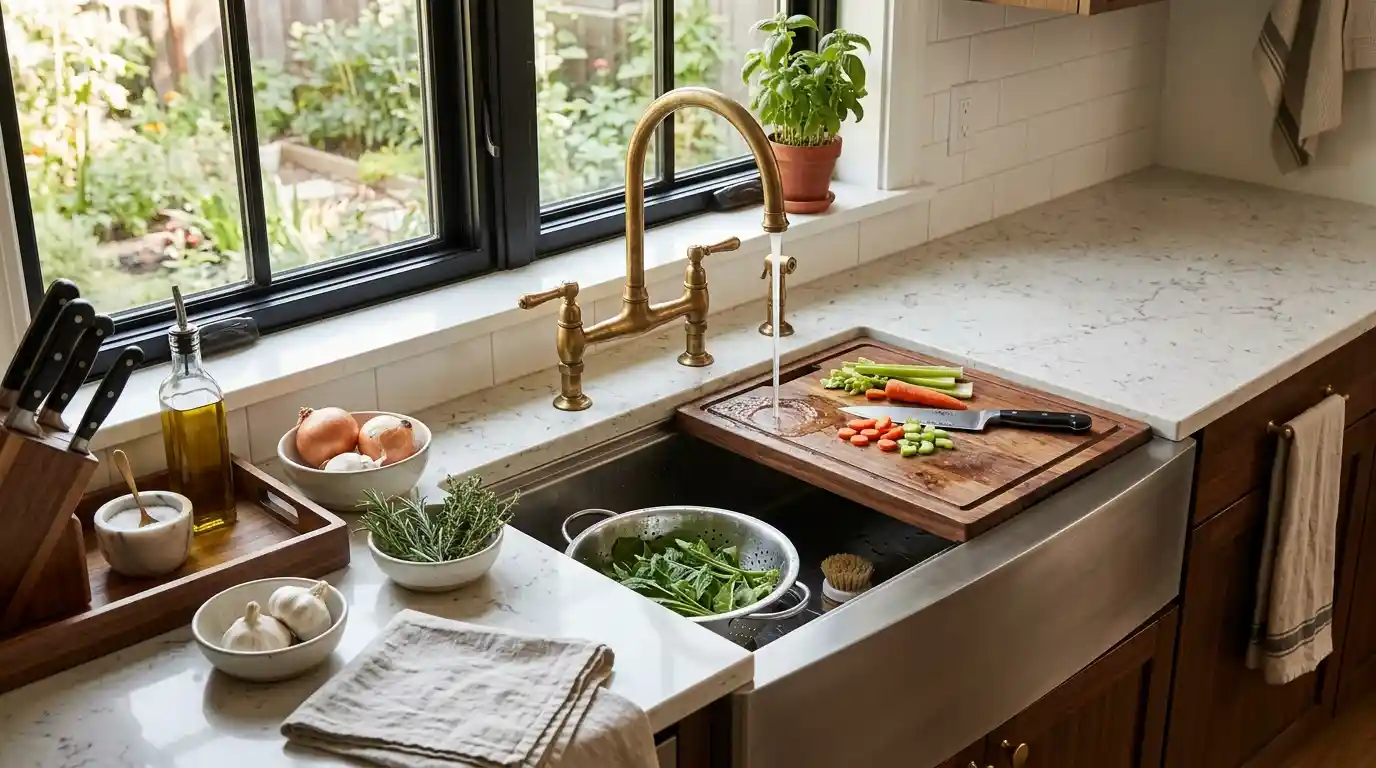
The workstation sink doesn’t get enough attention in kitchen remodeling conversations. It’s a deeper, integrated prep sink with fitted accessories cutting boards, colanders, drying racks that slide along built-in ledges over the basin. The prep zone becomes the sink. Paired with a touchless faucet and brass fixtures, it changes workflow in ways a regular undermount sink never could. Worth the investment, almost regardless of overall kitchen renovation budget.
Backsplash and Splashback — The Surface Most Remodels Either Nail or Completely Waste
The backsplash is probably the highest-impact surface per dollar in any kitchen remodel. A full-height backsplash running from worktop to the underside of upper cabinets or all the way to the ceiling shifts the visual weight of the whole kitchen. Zellige tiles have crossed from niche design choice to something approaching mainstream, especially in UK kitchen renovation projects. The handmade surface variation, the slight irregularity, and the way they catch light differently across the day none of that comes from machine-made subway tile.
Subway tile backsplash isn’t going anywhere in North America. What’s changed is how people are using it. Dark grout on white tile. Stacked vertical installation instead of the standard brick pattern. Oversized formats. Each of those reads as a specific design decision rather than the default. Mosaic tile backsplash and geometric tile backsplash make sense in kitchens where the cabinetry is intentionally understated letting the wall do the personality work. Glass backsplash and metal backsplash suit contemporary kitchen and minimalist kitchen aesthetics where adding surface texture would create visual noise rather than character.
The decision is really about whether the splashback is meant to be a focal point or a background. A kitchen where the island, cabinetry, and countertop materials are already competing visually needs a backsplash that settles things down, not adds to them.
Lighting — The Budget Line That Gets Cut and Shouldn’t
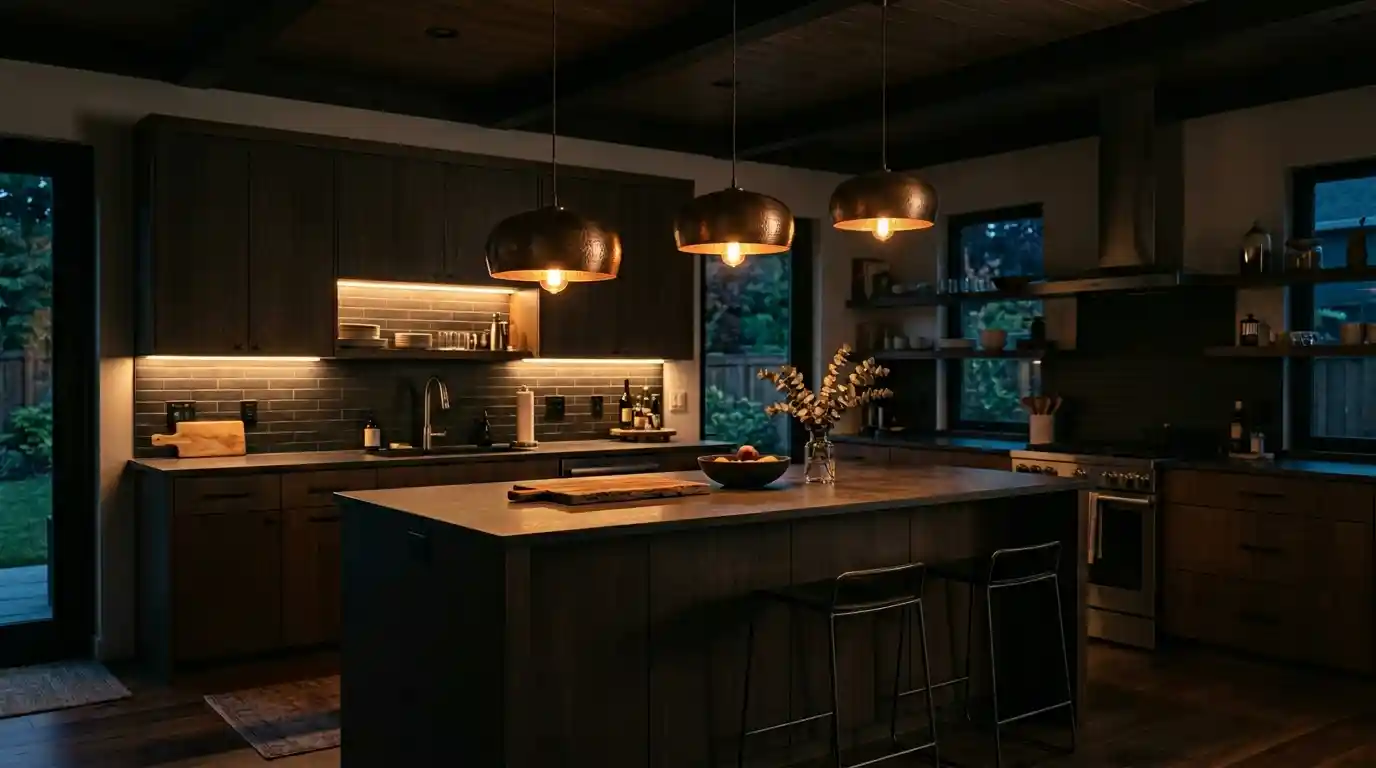
Under-cabinet lighting. Pendant lights over the island. Recessed lighting on a proper dimmer circuit. Do all three together and a kitchen feels like it was designed? Leave any of them out and something always seems slightly off, even if the person living in it can’t identify exactly why.
Most builders put in one overhead fixture and describe it as task lighting. It isn’t. It casts shadows precisely where you’re cutting vegetables and reading temperatures on a stovetop. Pendant clusters above a kitchen island define the island as a destination, not just a surface. LED strip lighting under upper cabinets and along toe kicks gives a kitchen dimensionality at night that recessed lights on their own can’t produce. Skylights where the roof allows make a bigger difference than any amount of artificial light layering. A daylit kitchen and a dark kitchen are different spaces to live in, not just different aesthetics.
Recessed lights, LED under-cabinet lights, and a statement lighting fixture together typically run $300 to $1,500 depending on whether new wiring is needed. That range represents the best dollar-for-dollar return in most kitchen renovation budgets, and it’s consistently the line item that gets trimmed when costs run over.
When the Footprint Is the Problem, Not the Finishes
Some kitchens can’t be fixed with a kitchen refresh. Cabinet repainting, new countertops, and updated hardware these are real improvements, but they don’t change the fundamental problem when the kitchen footprint is wrong. A side return kitchen extension on a UK terraced house recovering the narrow strip alongside the ground floor can turn a cramped galley kitchen into something with island space, a dining nook, and real indoor outdoor kitchen flow. A 7.1 by 1.8 meter side return addition completely reorganizes what was there before. That’s a different kind of kitchen remodeling idea, one that involves permit requirements, structural engineering, and a licensed contractor, but the outcome is categorically different from any surface renovation.
For US homeowners working within an existing footprint, removing a load-bearing wall to create an open plan kitchen is the equivalent move. The structural change and the cost that comes with it buys you a floor plan rather than just an updated kitchen. A minor kitchen remodel keeping the same layout runs roughly $10,000 to $20,000. Major remodel with layout changes and new cabinetry lands between $25,000 and $50,000. Full gut renovation to the studs can exceed $75,000. National averages sit between $14,597 and $41,509 for a complete kitchen remodel, with mid-range projects recouping 50 to 75 percent at resale.
Storage, Beverage Stations, and the Details That Keep a Kitchen From Feeling Dated
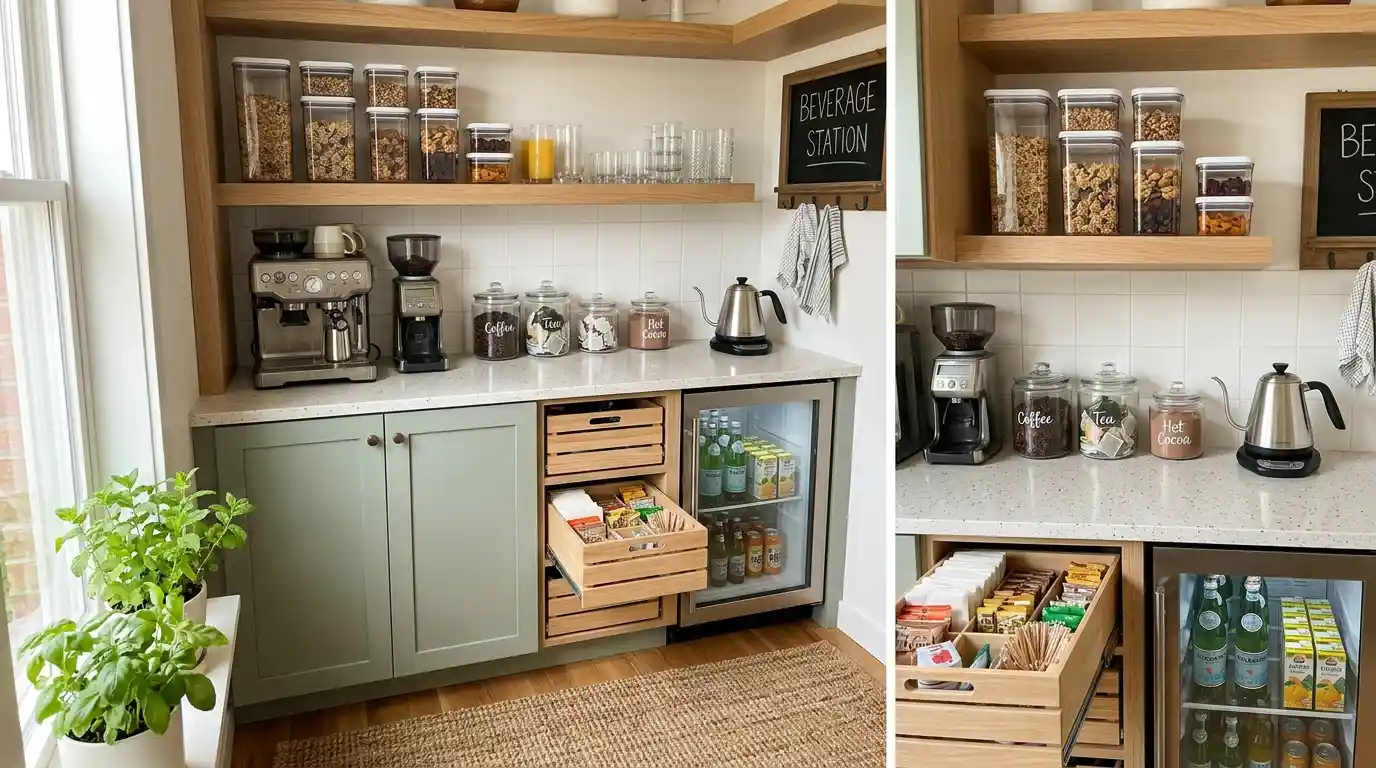
The coffee station kitchen dedicated counter corner, espresso machine, grinder, specialized storage, floating shelf for cups has stopped being a design aspiration and started being a practical feature request. The NKBA reports 85 percent of designer’s list beverage stations as a top lifestyle feature. That tells you something about how kitchens are actually being used: they’re morning rooms, they’re homework spaces, they’re gathering points that happen to also have a stove.
A well-designed kitchen island with built-in power outlets, prep sink, and breakfast bar can genuinely function as five different things in one day. Pull-out drawers, pull-out shelves, interior cabinet organization, and dedicated pantry storage whether that’s a scullery, butler’s pantry, or pull-out pantry column are the details that make a kitchen work rather than just look like it does. The dirty kitchen trend, which creates a secondary back kitchen for heavy food prep and appliance storage, exists specifically because open plan kitchen living creates visual pressure that most house holds weren’t prepared for.
Porcelain tile flooring remains the most durable kitchen flooring choice available scratch-resistant, waterproof, built for decades of heavy use. Luxury vinyl flooring has genuinely closed the visual gap with hardwood. Engineered hardwood flooring handles humidity better than solid wood. Cost runs from $3 to $10 per square foot for vinyl and linoleum flooring, up to $14 to $30 per square foot for hardwood floors depending on species.
Bamboo cabinetry, reclaimed wood shelving, cork flooring sustainable kitchen materials are showing up not as trend choices but as considered, values-led ones. Energy efficient appliances, app-controlled appliances, touchless faucets, smart kitchen technology. These are what future-ready kitchen remodeling ideas actually look like, and they integrate better than they ever have into kitchens that also just look right.
The kitchen renovations that hold up over years that don’t look tired by 2028 or feel wrong to cook in after the novelty wears off are nearly always the ones where someone fixed the floor plan before they picked a single finish.
Conclusion
Good kitchen remodeling ideas aren’t hard to find the internet is full of them. The difficult part lies in discerning what matters to your particular home, your budget, and your cooking style. Good home renovation jobs are achieved through taking the time to make changes to the structure and then adding finishing touches. That order is everything.
Frequently Asked Questions (FAQ’s)
Start with the kitchen layout before choosing cabinets, countertops, or finishes. The cooking, preparation, and cleaning zones should work together so the kitchen remains practical for everyday use.
A galley kitchen can be highly efficient because everything stays within easy reach, especially in smaller spaces. L-shaped and U-shaped layouts offer more flexibility when you have enough room for additional storage or a kitchen island.
Use floor-to-ceiling cabinets, pull-out shelves, deep drawers, appliance garages, and dedicated pantry storage to make better use of available space. Storage should be planned around what you actually use rather than added only for appearance.
Quartz is easier to maintain and better suited to busy kitchens, while marble offers natural character but requires more care around stains and marks. The right choice depends on how much maintenance you are comfortable with.
A full remodel makes more sense when the existing layout, footprint, or workflow is the real problem. If the layout already works, updating cabinets, hardware, countertops, lighting, or backsplash may be enough.

9 thoughts on “Kitchen Remodeling Ideas: Layout, Storage & Design Tips”