
However, all landscaping discussions begin with the wrong topic, namely, choosing which plants to use and why. This is the type of discussion which Morph Design Co tries to steer away from in the name of landscape morphing. While the concept of morphic gardening involves working with plants in particular ways, the overall morphic garden design philosophy starts with consideration of the space that will be worked with including the movement of light within that space, the structure that it will complement, and the movement of humans through it.
From experience with numerous garden designs, it is apparent that the gardens that people tend to be attached to the most do not necessarily contain many different kinds of plants but result from some conscious choice of an architect or a garden designer. It is essential to understand what makes a garden morph landscape design special for those who have just started landscaping and wish to renovate their yards.
Why Structure Always Outperforms Planting Volume in Landscape Design
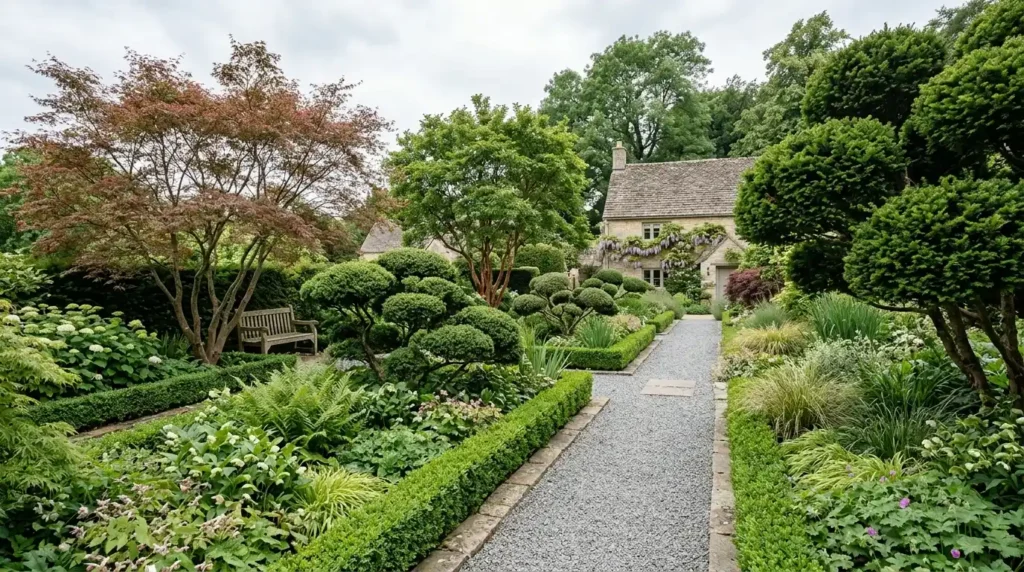
Front yard landscape ideas, backyard landscape ideas, and courtyard garden ideas that age well all share one common attribute: they possess “bones.” Clear planting edges, defined structure throughout the year, the creation of rooms through zoning rather than treating the entire area as one unified outdoor space.
Landscape Morphing
Landscape morphing is a theory which recognizes that the garden changes as it moves from one season to the next, from one function to another, and from indoors to out right down to its ultimate edge rather than remaining as an eternal fixture of planted objects. It is precisely because of this reason that one sees recurring images of multi trunked trees, cloud-pruned evergreens, architectural plantings, and sculptural greenery in well-designed modern landscapes that endure over time.
Triple Layer Planting
This translates into a triple layer planting approach in practice. The canopy layer is where the planting happens vertically along with the shade provision. The mid-story layer shrubs, ornamental grasses, tall perennials add the movement and discovery that give depth to the garden. Whether it is a ground cover idea, gravel and pebble concept, or mass planting idea for low-lying plants, the ground layer completes the picture.
Garden Designer Or Landscaper
A garden designer or landscaper following this approach would begin by planning features such as retaining walls, curved pathways, stepping stones, gravel walkways, pergolas, and outdoor dining spaces before focusing on plant selection. In this framework, hardscaping establishes the structure, while the planting brings the design to life within that framework.
Material Honesty and the Modern Landscape Palette
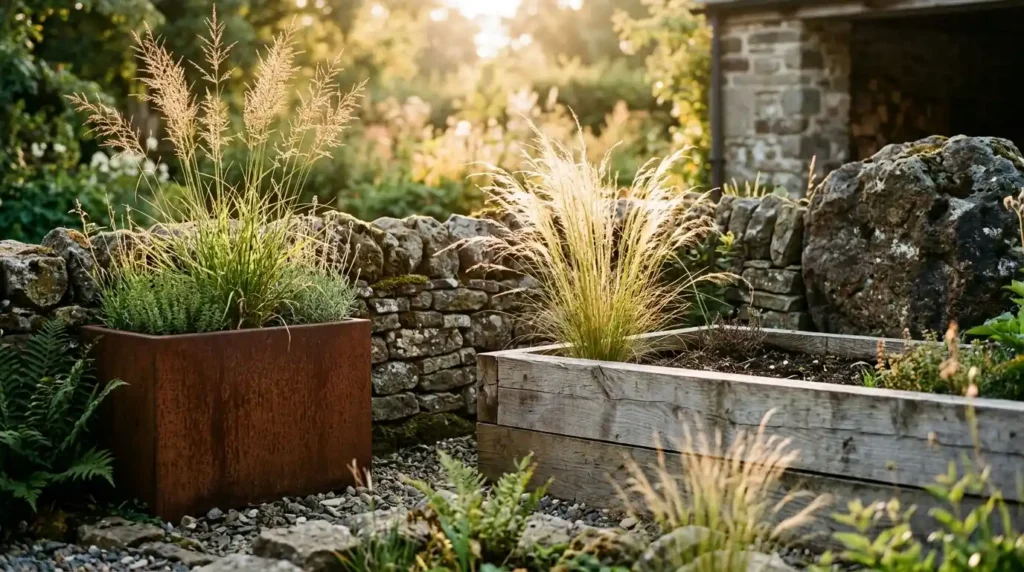
One of the defining signatures of morphic garden design and of the broader organic landscape design movement it relates to is an unapologetic use of raw, honest materials. Corten steel landscape applications: Corten steel planters, corten planter arrangements, dry stone wall sections, gabion wall structures, oversized stone landscape features, raw timber landscape elements, raised timber bed constructions, and raw log seating. These materials do something synthetic alternatives never quite manage: they age into the garden rather than against it.
When Corten steel is exposed to rainwater, the effect on the material will be to create an exterior which blends into the soil environment surrounding it. A stone wall, through its slow development as a habitat feature for insects, a nesting area for birds, and as a growing medium for mosses, can become a feature in a habitat garden.
Boulder Placement
Boulder placement is another element that separates considered outdoor room design from generic landscape renovation. A single well-placed oversized stone treated as an outdoor focal point or anchor planting companion can do more for the visual balance of a garden than a dozen plants. It creates weight, reference, and a sense that the landscape has geological history even when the installation is brand new.
Pathways generally seem to work better if they form an integral part of the design as opposed to merely being added afterwards. The idea of curvy walkways and pathways is interesting because there is movement and mystery in them since you can’t see the whole garden in one shot; this is what gives the garden the illusion of space. Some of the stone paths that incorporate some irregular geometries and the use of gravel mulch between stones to create pathways add depth to the overall landscape design.
Water, Sustainability, and the Genuine Cost of Getting It Right
The environmental pressure on landscape design has shifted dramatically. Drought-tolerant landscape ideas, xeriscaping ideas, native plant landscape ideas, rain garden ideas, and water-wise landscape ideas have moved from fringe approaches to mainstream expectations in a short period of time, particularly in California where programs like the Santa Monica rebate program offer $3.50 per square foot for turf replacement, up to $6,000, under frameworks like California Title 24.
The Alliance for Water Efficiency has documented 50% water reduction in xeriscaping versus traditional lawn a figure that makes the $5,000 to $24,000 total xeriscaping cost range look considerably more reasonable when spread across a 3 to 5 year xeriscape ROI payback period.
Xeriscaping Cost For Professional Installation
Xeriscaping cost for professional installation of a 500-square-foot xeriscape runs $3,500 to $9,165. A 500-square-foot DIY xeriscape costs $4,500 to $5,500 depending on material choices and whether drip irrigation is included. For a 1,200-square-foot xeriscape, the average cost is $17,000, with a design cost range of $10,000 to $30,000 for complex or sloped sites. Material costs run $3 to $10 per square foot for xeriscape materials, and drip irrigation adds $1.50 to $4.50 per square foot for professional installation or $0.50 to $1.00 per square foot for DIY drip irrigation systems.
Rainwater harvesting through a rain barrel typically $80 to $120 per recycled rain barrel and permeable paving instead of sealed hardscape are practical additions that reduce stormwater runoff and reduce irrigation requirements over the long term. A smart irrigation system or soaker hose setup, combined with organic mulch or gravel mulch to reduce evaporation, handles most of the ongoing maintenance water demand that traditional gardens carry.
Native Plant Landscape Ideas
Native plant landscape ideas and wildlife garden ideas pollinator garden, bee-friendly garden, butterfly garden, bird-friendly garden, habitat garden, biodiversity planting deliver a 20% to 30% reduction in landscape maintenance costs compared to conventional planting, according to the National Association of Landscape Professionals. The savings are real and accumulate quickly.
Planning a Landscape Renovation: What the Numbers Actually Tell You
Professional Landscape Design Costs
Professional landscape design costs $5 to $45 per square foot for design-and-build work, or $0.05 to $0.75 per square foot for design-only plans. The average landscape design plan cost is $4,590, with a cost range of $1,955 to $7,220 for most residential projects. A simple quarter-acre native plant path project might start at $500 minimum, while a complex garden plan cost can reach $15,000. Landscape designer consultation runs $50 to $150 per hour.
Substantial Landscape
For substantial landscape upgrades involving patios, walkways, and irrigation, the typical investment sits between $10,000 to $50,000 plus for full transformation. Stone walkway installation costs $16 to $35 per square foot installed, with stone paver material running $7 to $18 per square foot. DIY garden bed kit options start at $5 to $15 per square foot, while custom garden bed installation ranges from $20 to $65 per square foot.
Quality Landscaping
Quality landscaping delivers 5% to 12% property value increase and curb appeal improvement of 15% to 20%. Those returns make the investment logic fairly clear the question isn’t whether to invest in landscape design, but where in the design to concentrate the available budget.
Platforms
Platforms like Houzz, Angi, Lawnstarter, Lawnlove, and HomeGuide have made it easier to find a landscape contractor, landscape company, or landscape firm locally. Resources from Better Homes and Gardens, Garden Design Magazine, Architectural Digest, Homes and Gardens, House Beautiful, Veranda, and Dwell offer landscape ideas catalogued by style and scale.
The ASLA and horticultural experts like Liesel Hans Ph.D. and designers like Shaina Barnum of Shaina B Design represent the credentialed end of landscape design practice where the larger, more complex projects benefit from professional oversight.
Planting for Feeling, Not Just Function
Every garden design decision whether it’s a cottage landscape, Mediterranean landscape, Japanese landscape, coastal landscape, or prairie planting-influenced contemporary garden ultimately comes down to how the space makes people feel when they’re in it.
Sensory garden design, fragrance garden elements, therapeutic garden thinking, wellness garden and mindfulness garden design are not separate categories from good landscape design. They are the destination of good landscape design.
Textural Planting
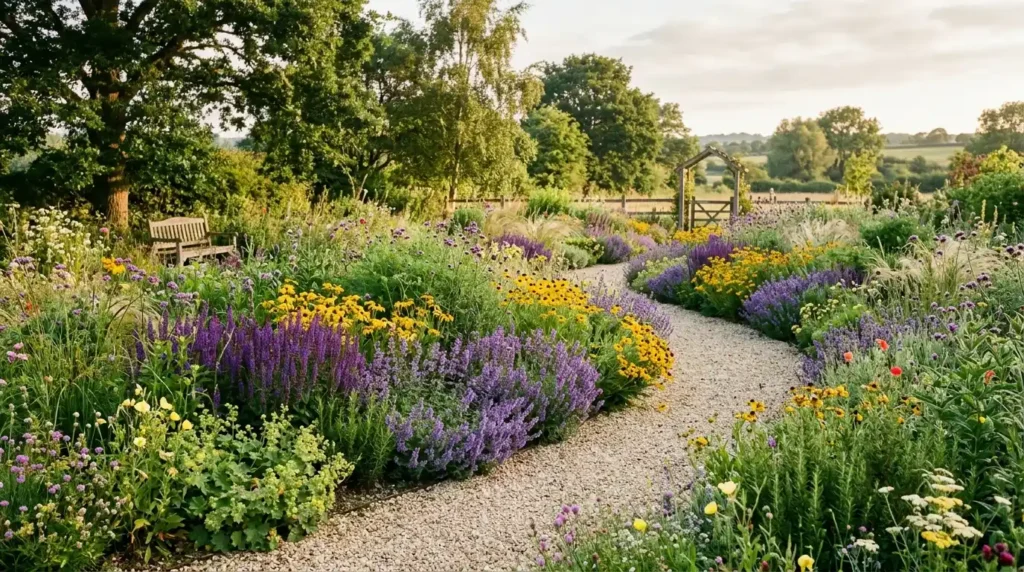
Textural planting fine texture plants against bold texture plants, contrast planting strategies, color and texture layering, repetition in planting that creates rhythm, drift planting and mass planting for visual continuity these are the tools that create sensory gardens without naming them as such.
A monochromatic garden in silvery grays and whites is calming not because someone labeled it a wellness garden, but because the visual noise has been removed. A complementary color planting combination of deep purple and acid yellow is energizing for the same sensory reason.
Garden Rewilding Ideas
Garden rewilding ideas, meadow gardens, and wildflowers ideas are concepts that create a new sort of emotion, one of giving to the non human world. A regenerative garden that follows the concepts of the compost garden, soil amendment, composting, and mulching strategy is not only more ecologically conscious but creates healthier plants with less effort, which leads to a more low maintenance landscape, the real goal of anyone who wants a gorgeous garden.
The types of landscape design that last are those in which someone took time to consider what their outdoor space needed to be before selecting the elements it required: front garden ideas, back garden ideas, sloped garden ideas, terraced garden ideas, shady garden ideas, sunny garden ideas, rooftop garden ideas, and walled garden ideas.
Conclusion
An effective landscape does not arise out of specific plantings or costly construction materials. An effective landscape arises out of the thought processes that take place beforehand. Whether the landscape project involves hiring a landscape architect to create an estate landscape plan, contracting with a landscape contractor to remodel the front yard, or developing do it yourself landscaping designs on a limited budget, the concept stays the same. Form and structure come first, then planting comes afterward. The most effective outdoor areas feel as though they were meant to be.
Frequently Asked Questions (FAQ’s)
Landscape morphing is an approach that treats a garden as a changing space shaped by seasons, movement, function, structure, and planting. The goal is to create an outdoor area that evolves naturally rather than relying on plants alone.
Hardscaping and structure should usually come first because pathways, retaining walls, pergolas, and outdoor zones establish the framework of the garden. Plants can then be layered into that structure to add movement, texture, and seasonal interest.
Use drought-tolerant or native plants, mulch, permeable paving, drip irrigation, and rainwater harvesting where suitable. Xeriscaping can further reduce the amount of water and routine maintenance a traditional lawn requires.
Not always. The article notes that material choices, irrigation, site conditions, and project size can make DIY xeriscaping surprisingly costly, so comparing the complete project cost before deciding is worthwhile.
Professional help makes sense for larger or more complicated projects involving slopes, retaining walls, patios, irrigation, zoning, or a complete garden transformation. Smaller landscape ideas and planting improvements may be practical to handle yourself with a clear plan.

10 thoughts on “Landscape Ideas From Morph: A Design First Approach to Outdoor Spaces That Actually Last”