
There is a moment, usually early in a project, when a client walks into a space and goes quiet. Not because there is nothing to say but because something in the room is already saying it. The proportions feel right. The light arrives at the right angle. The materials speak in a register they recognise but could not have asked for. That moment is what architecture is all about, and I have spent enough years chasing it to know it doesn’t happen by accident.
Most people, when they first ask what architecture means, expect a definition. What they actually need is a frame a way of understanding how the built environment thinks, how spatial design makes decisions before the first wall goes up, and why the difference between a room that works and one that merely exists is almost never visible in the floor plan.
The 2,000-Year-Old Argument Still Running Every Design Decision
Vitruvius, a Roman engineer writing in the 1st century BC in his treatise De Architectura, gave the field its first and most durable framework: firmitas, utilitas, venustas. Strength, utility, beauty. Or in the translation that has stuck with me since architecture school durability, commodity, delight. The Vitruvian Triad is 2,000 years old and still the most honest description of what architectural design is trying to do simultaneously, in every single project, without letting any one of the three collapse the other two.
Firmitas is the part nobody romanticises the load-bearing logic, the material selection that has to outlast weather and budget cycles both, the building codes that exist not as bureaucratic friction but because habitable space carries a genuine duty of care. Utilitas is harder to photograph than venustas but more present in daily experience: how space planning actually serves human occupancy, how circulation moves through a building without forcing it, how HVAC systems, plumbing, ventilation, and the placement of load-bearing elements end up shaping a room’s quality in ways no one notices until they’re absent. Venustas beauty, delight gets the headlines. What the other two do is make it possible.
Marcus Vitruvius Pollio was not writing philosophy. He was writing engineering. The Vitruvian Man that Da Vinci drew fifteen centuries later was a response to that same text an argument that the human body and the built environment share a proportional logic that is not decorative but structural. That argument has not aged. It has only become more urgent.
What Architects Actually Do That Interior Designers Don’t
The question comes up in every client meeting eventually, and it deserves a straight answer. Architecture vs interior design is not a hierarchy it is a scope boundary. Interior design is the practice of creating interior atmospheres: finishes, furniture selection, colour palettes, fittings, equipment, the compositional design of a room within a given shell. Interior architecture reaches into the shell itself. It addresses structural adaptation, window and door placement, load-bearing walls, adaptive reuse of existing buildings, partition redesign, interior restructuring the things that require a licensed architect because they involve building structure and building codes, not just surfaces.
Interior designers need an eye for style. Interior architects need architectural literacy the ability to read a building’s structural logic and intervene in it responsibly. Both require technical knowledge, design creativity, and genuine communication skills, but they are applied at different depths into the built environment. The overlap is real and often productive. The distinction matters most when someone wants to transform a space rather than dress it.
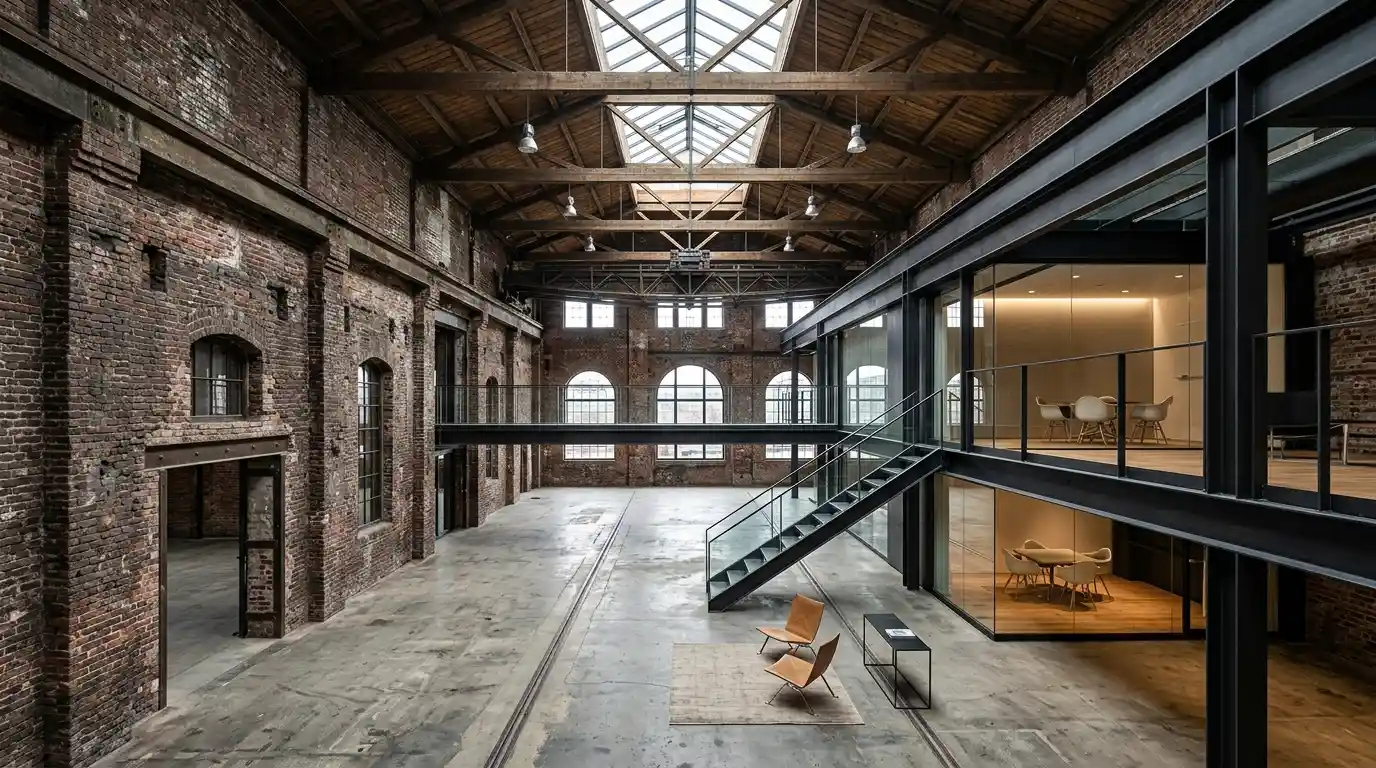
I have worked on projects where the brief was presented as a decoration question and turned out to be a structural one. An old warehouse in a heritage listed block, a retail unit that needed to become a hospitality space these are adaptive reuse problems, not styling problems. They require architectural reconfiguration, a knowledge of embodied carbon, heritage conservation principles, and the ability to carry historical memory into a new spatial narrative. That is interior architecture, and it is a different discipline from choosing a colour palette, however good the palette is.
The Principles That Actually Govern Space — and Why They’re Not Rules
Balance, proportion, scale, unity, rhythm, emphasis, hierarchy, contrast, datum, axis, symmetry, asymmetry every architecture degree covers these. What most graduates discover in practice is that these are not rules to follow but tensions to manage. A building that achieves perfect symmetrical balance is not automatically better than one that uses asymmetry deliberately. Scale is not about size it is about the ever-changing size relationship between design elements in terms of ratios, and how that ratio makes the person standing in the room feel either contained or released.
Proportion does something most clients cannot name but every client feels immediately. Get the ceiling height wrong relative to the floor area and it doesn’t matter what else you do — no amount of biophilic design, living walls, or carefully considered daylighting through clerestory glazing will correct what a bad proportion does to a person’s comfort in a room. Visual weight, visual harmony, visual flow are not soft concepts. They’re spatial logic running on the human nervous system, and understanding that mechanism well enough to direct it deliberately is most of what architecture school is actually training you to do.
Rhythm in architecture orchestrates how the eye moves regular spacing of windows, repetition in structural elements, and continuity across a facade. Hierarchy establishes what the building is asking you to look at first. Emphasis is where the focal point lands. Contrast gives depth to any of these, providing a register shift that makes the rest of the composition legible. Datum and axis are the invisible organisers the linear progressions that other forms and spaces respond to even when no one can point at them.
Human-Centric Design Is Not a Trend — It’s the Entire Point
Spend enough time in client briefings and you start noticing how often the phrase “human-centric design” gets introduced as if it arrived recently, as if someone in 2019 finally thought to ask whether buildings should work for people. Vitruvius called it utilitas in the 1st century BC. The vocabulary has changed experiential design, wellness architecture, soundscape design, psychological comfort, predictable comfort but the argument is the same one. Spaces have to serve the people inside them, and not in a passive way. Commercial interior architecture heading into 2026 has put human well-being, adaptability, and high-performance design squarely at the centre of the brief, which is only remarkable if you forgot they were supposed to be there from the start.
Biophilic design is a good example of this pattern. In its current form it is not a feature wall of plants bolted on at the end of a project it is a design methodology that gets established during schematic design and shapes spatial planning, material specification, and structural decisions from that point forward. Living walls, indoor gardens, green roofs, water features, courtyards positioned to be visible from multiple rooms these are spatial decisions that alter adjacency relationships inside a building and change how light moves across rooms at different hours and seasons. You cannot retrofit that logic without starting over.
The market numbers reflect what the spatial logic has been pointing at for a while. Interior design growing toward $204 billion by 2031, running at a 5.83% CAGR, with residential demand sitting at 57% of that none of that is people wanting prettier rooms. It is people who have spent enough time in spaces that do not work for them finally putting money into ones that do. Architecture and wellbeing, architecture and productivity, architecture and quality of life stopped being separate conversations some time ago.
Sustainable Architecture and the Responsibility That Comes With Material Selection
Net-zero design, NZEB, LEED, BREEAM, WELL certification, circular construction, design for disassembly, regenerative materials, low-emission materials, embodied carbon reduction right now these read as the specialist vocabulary of sustainable architecture in 2026, and they are. But strip the acronyms out and what remains is firmitas again: build it to last, build it to genuinely serve, build it in a way where the environmental cost of its existence doesn’t quietly cancel out whatever quality of life it was supposed to provide.
Nowhere does this become more concrete than in adaptive reuse projects. Working with an existing building an old factory, a redundant warehouse, a deconsecrated church, a historic structure that the original brief said to knock down forces decisions that new construction lets you avoid. You cannot specify your way out of an existing floor plate. You work with what the building already knows how to do, and you find the new programme inside a shell that carries its own history. That constraint is not a limitation. It produces some of the most architecturally specific spaces I have seen, because the decisions were real ones made against real resistance, not selections from a catalogue.
Climate-resilient architecture, geothermal energy systems, solar panels, insulated facades, roof apertures mapped to daylight movement across different seasons these stopped being optional extras on serious projects a while back. They are structural decisions now, the same way load-bearing walls are structural decisions. Firmitas, in 2026, includes accounting for what the environment outside the building is doing and building something that can answer it honestly.
What the Basics of Architecture Are Really Teaching
The basics balance, structural integrity, functional spatial planning, material technology, site planning, topography, landscape integration, contextualism are not a starting point you graduate from. Every project I have worked on, regardless of scale or budget, eventually comes back to the same fundamentals. A luxury custom home and a public cultural space in a European city centre are asking the same questions in different registers.
What architecture as art and science actually means in practice is that the science narrows your options and the art chooses between them. The load-bearing logic, building codes, structural adaptation, daylight analysis, acoustic engineering, and the environmental behaviour of materials across decades these close off the bad answers. What remains after that is still a hundred possible buildings, and the one you build is the one where proportion, material selection, spatial narrative, and emotional response align well enough that someone walks in and cannot immediately explain why it feels right. That gap between what the science permits and what the art selects is where architecture actually lives. I have been working in it long enough to know I will never completely close it, and that is probably the whole point.
Conclusion
There is no final answer to what architecture is all about only a deeper fluency with the question. The Vitruvian Triad still holds. The fundamentals still govern. The moment when someone walks into a room and goes quiet still matters more than any specification sheet or certification acronym. At KDA Interiorment, that moment is not the happy accident at the end of a project. It is the thing the project was organised around from the beginning the standard against which every structural decision, material choice, and spatial relationship is quietly measured.
What architecture is all about, in the end, is accountability. Responsibility to the person who will live or work inside the space. Accountability to the building’s own structural logic. Accountability to the environment that building will have to answer to for the next fifty years. The science narrows the options. The art chooses between them. What KDA Interiorment brings to that gap between what the brief asks for and what the space ultimately becomes is the kind of architectural literacy that knows the difference between a room that exists and one that works. That difference is what we are here for.
Frequently Asked Questions (FAQ’s)
Architecture is about creating spaces that balance structural strength, practical use, and human experience. Good architectural design considers how a building works, feels, lasts, and responds to the people who use it.
Architecture deals with the building’s structure, spatial organization, walls, openings, building codes, and major physical changes, while interior design focuses more on finishes, furniture, colors, and the atmosphere within an existing space.
Architects use principles such as proportion, scale, balance, hierarchy, circulation, and material selection to connect appearance with practical performance. Beauty works best when it grows from a space that already functions well.
An architect or interior architect is generally needed when a project involves structural changes, load-bearing walls, major space reconfiguration, adaptive reuse, or decisions governed by building codes. Interior design is more suitable when the existing structure remains largely unchanged.
Sustainable architecture considers energy use, embodied carbon, durable materials, climate resilience, and the long-term environmental impact of a building. The goal is not simply to build efficiently, but to create spaces that remain useful and responsible over time.

16 thoughts on “What Architecture Is All About — KDA Interiorment”