
Nobody talks about doors the way they talk about kitchens or bathrooms. And yet a door is the first physical thing a visitor touches. When they arrive at your home, and the last thing they interact with when they leave. It sets the tone before anyone steps inside. It determines how sound travels through your rooms. How much heat escapes in winter, how private your bedroom feels at 11pm. And whether a would-be intruder moves on to easier targets. I’ve made the mistake myself spending weeks agonizing over tile. And ignoring the front door entirely until a contractor pointed out that the entry door I’d inherited from the previous owner was leaking conditioned air around a frame that had never been properly sealed. The energy savings from replacing it covered a meaningful portion of the project cost within three years.
Doors are functional architecture. And in 2026, the choices available across door types, materials, hardware systems, and design languages are more considered and more varied than at any point before.
Why the Type of Door You Choose Changes Everything Downstream
The door replacement or door installation decision begins with mechanism, not material. And the right mechanism for a space is determined by how the space is used. Not by what looks good in a showroom.
Swing Door
A swing door the standard hinged door. Most homes are built with remains the most practical general purpose choice for bedrooms, bathrooms, entry doors, and most interior applications. Pre hung door units are faster and typically less expensive to install than slab door options. Because the frame, shimming, and leveling work is already done at the factory.
For most straightforward door replacement projects, a pre hung unit in a matching rough opening delivers the cleanest result.
Pivot Door
A pivot door operates on a floor spring and top pivot rather than side hinges. Which makes it the right choice when the required door opening is substantially larger than standard grand entrance applications. Floor to ceiling doors in high ceiling spaces, or oversized architectural doors. Where a standard hinged door would be too heavy to operate smoothly.
Pivot doors are much thicker than standard door wings. And require specific hardware like the Tedee PRO smart lock. Which was designed specifically for the pivot door’s unusual geometry.
Pocket Door
A pocket door disappears entirely into the wall cavity when open. Which makes it the preferred solution for small bathroom privacy situations. Where a swing door would consume too much floor area. Or for narrow hallway applications where door clearance is genuinely constrained.
The tradeoff is installation complexity. Pocket door installation requires cutting into the wall cavity. And acoustic performance is lower than a solid core swing door. For home office applications where sound reduction matters, a solid core hinged door almost always outperforms a pocket door.
Barn Door
A barn door slides on an external track and has become, over the last several years. One of the most searched door ideas for bedroom and bathroom applications. The appeal is visual the hardware becomes a feature rather than a hidden component. And the installation is more accessible as a DIY door installation project than a pocket door or pivot door.
The limitation is privacy. Barn doors don’t seal against the frame the way a hinged door does. Which matters more in a bedroom than in a pantry.
Bifold Door
Bifold door and accordion door configurations work best for closet door applications, laundry room doors, and interior openings where full clearance is needed but swing clearance isn’t available.
Multi point locking systems, including shoot bolt hardware and auto lock systems, have substantially improved bifold door security for exterior applications addressing the historical weakness of single-point locking in larger bifold configurations.
French Door
French door designs bring natural light and visual connection between spaces full lite glass or half-lite glass panels, sidelight and transom window additions, and double door configurations that work particularly well between a kitchen and a garden or between a living room and a dining room.
Sliding glass door systems and bypass sliding door configurations serve similar indoor outdoor connection functions at a lower cost per square metre than traditional French door installations.
Material Is the Decision That Determines the Next Twenty Years
Once you’ve resolved the mechanism question, material choice is where the door’s long-term performance is decided. And this is where personal experience matters most because the theoretical properties of each material and the daily reality of living with them are not always the same thing.
Solid Wood Door
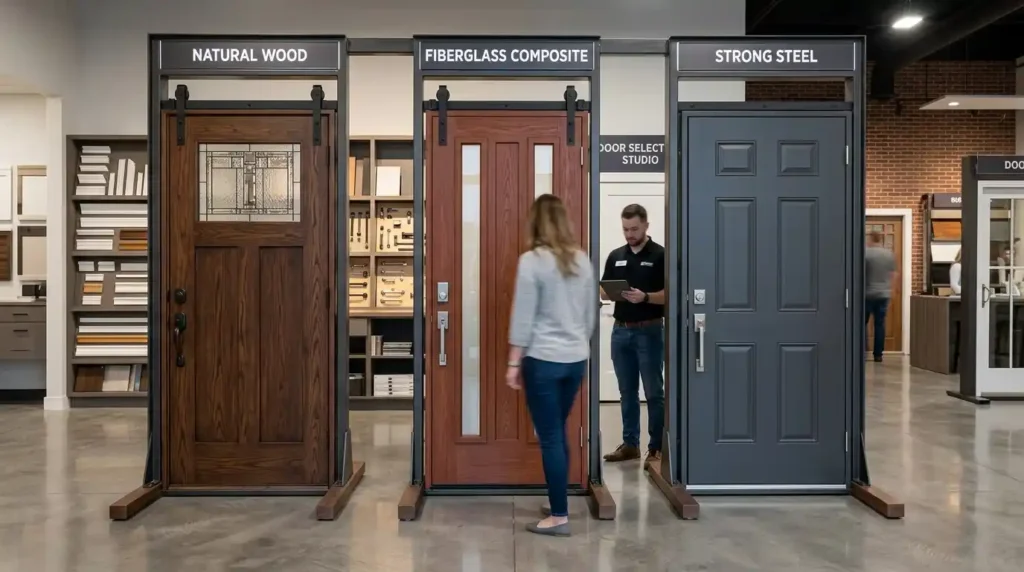
A solid wood door oak door, walnut door, mahogany door, white oak door, dark walnut door, or reclaimed wood door is the warmest and most architecturally satisfying choice available. Natural patina develops over time in a way that only improves the character of a quality timber door.
The limitation is dimensional stability: solid wood doors expand and contract with humidity, which means that in climates with significant seasonal moisture variation, a solid wood door needs proper sealing, correct frame clearance, and periodic maintenance to continue operating smoothly. An engineered solid wood door or timber veneer construction offers better dimensional stability than pure solid wood while retaining most of the visual warmth.
Fiberglass Door
A fiberglass door is the practical performance choice for most exterior door and front door applications. Fiberglass resists warping, cracking, rot, and impact damage in a way that wood cannot without ongoing maintenance. The best fiberglass doors now use wood inspired models and organic texture surfaces that are difficult to distinguish from real timber at a glance a significant improvement over the earlier generation of fiberglass doors that read unmistakably as synthetic.
For coastal storm door situations or salt-air resistant door requirements, fiberglass with appropriate UV-stable finishes outperforms all alternatives.
Steel Door
A steel door prioritizes security and thermal performance. Steel resists burglar-resistant door breach attempts, doesn’t warp or crack over time the way wood can, and insulated core or foam filled core steel doors deliver strong energy performance with properly sealed, energy efficient door installations stopping up to 30% of heat loss that a worn or poorly fitted door allows.
The tradeoff is tactile: a steel door doesn’t have the warmth of wood underhand and tends to dent rather than scratch if impacted. For entry door applications where security is the primary concern, a steel door with multi point locking is difficult to beat at its price point.
Aluminum Door
An aluminum door and uPVC door or PVC door are common in European door markets, particularly for bifold door, sliding door, and large format door configurations where span and weather sealing requirements exceed what timber can practically achieve. Composite door construction combining timber cores with GRP or aluminum outer skins offers a useful middle position: timber warmth inside, weather-resistant exterior surface outside.
Hardware, Finishes, and the Details That Complete the Picture
The door is only half the visual equation. Door hardware handle, lockset, hinges, and any smart lock integration determines both the security level and the design finish of the installation.
Matte Black Door Hardware
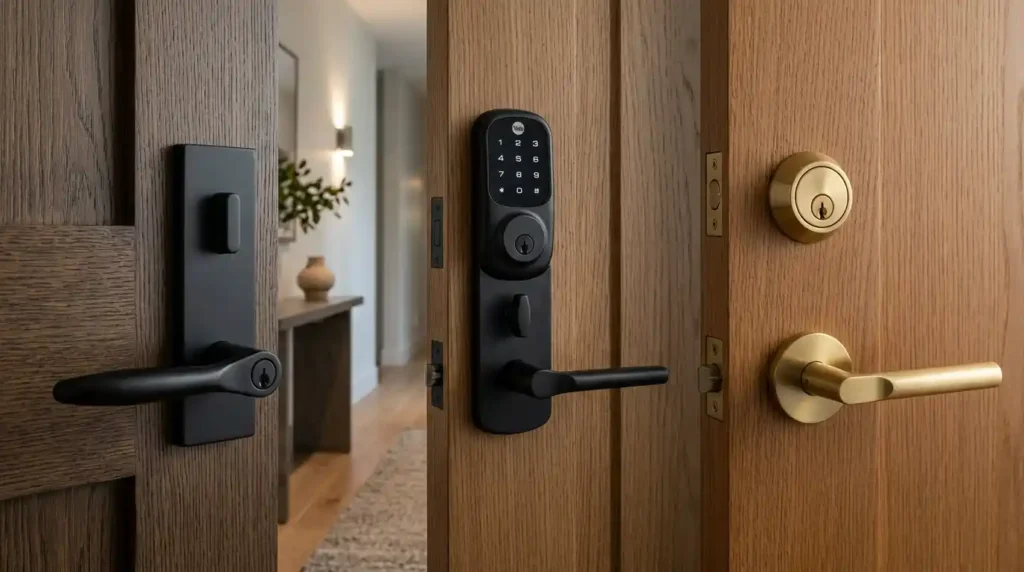
In 2026, matte black door hardware remains the most universally compatible finish choice across modern door design, contemporary door design, and minimalist door design contexts. Brushed brass hardware has maintained its position in transitional and warm toned interior applications. Chrome finish reads more cleanly in industrial door and Scandinavian door design schemes.
Security Hardware
For security hardware, the shift toward smart lock, electronic lock, and keypad lock systems has accelerated significantly. A smart lock from brands like Schlage, Kwikset, or Yale can provide app based and voice controlled access while still offering a traditional physical key option that many homeowners prefer.
Deadbolt installation with a high security lockset handles and locksets ranging from $40 to $500, deadbolts adding $30 to $200 remains the baseline for any exterior door or front door installation.
Multi-Point Locking Systems
Multi point locking systems distribute locking force across multiple engagement points rather than a single mortise lock point making the door significantly more resistant to forced entry.
The concealed inline track design of premium multi-point systems also prevents the anti lift mechanism vulnerability that single point locks leave exposed. For an exterior bifold door or patio door, multi-point locking with weather sealing integration is the standard that a quality installation should meet.
Door Finish And Color
Door finish and color are where the design personality of the choice expresses itself. Natural wood finish is the dominant trend in 2026 oak, walnut, birch, and reclaimed wood tones have displaced the painted white door dominance of the previous decade.
Where bold color is introduced, it tends to be deep and saturated: charcoal door, forest green door, matte black door, deep blue door, graphite door, or espresso door at the front entry. Inside the home, flush surface and flat panel doors in matte finish white, off-white, beige, gray continue to work because they recede architecturally and let other design elements come forward.
What Door Installation and Replacement Actually Costs in 2026
The average cost to install a new interior or exterior door runs $338 to $1,488, covering the door, labor, mounting hardware, threshold, and supplies. Interior door installation specifically hanging a pre-hung unit in an existing frame runs $100 to $300 in labor with most handyman services, while exterior door labor ranges from $300 to $600 and up.
Standard door installations take 2 to 6 hours for straightforward swaps; complex installs involving reframing, rot repair, mold remediation, or widening door opening can extend to a half day or full day.
Front Door Replacement Cost 2026
Front door replacement cost 2026 for a prehung entry door sits at $1,200 to $6,000 installed as the standard range, with a good better best structure that most experienced installers use: $1,200 to $2,200 for a solid steel prehung door with minimal upgrades, $2,200 to $3,800 for upgraded steel or fiberglass with stronger sealing and nicer hardware, and $3,800 to $8,000 and above for fiberglass with glass packages, sidelights, transoms, premium handleset, and upgraded security.
Custom door cost starts at $1,000 and can reach $10,000 or more, with custom door labor beginning at $1,300.
Additional Cost Factors
Additional cost factors that catch budgets off-guard include permit fee requirements of $50 to $300 depending on jurisdiction, fire-rated door premium costs of $300 to $800 installed above a non-rated equivalent, unlevel floor adjustment costs of $50 to $200, and rot or mold in framing repairs running $150 to $400.
Regional cost variation of 20% to 30% means that a $1,500 installation in a mid-sized inland city may cost $1,800 to $1,950 in a coastal metropolitan area.
ROI Argument
The ROI argument for front door replacement is well established: quality landscaping-equivalent return of 75% cost recouped on resale, with $200 per year energy savings on a properly sealed energy efficient door installation pointing toward a 7 to 10 year energy payback on the upgrade investment.
A $1,500 door installation adds approximately $1,100 to home value making it one of the better per dollar home improvement decisions available.
DIY Door Installation
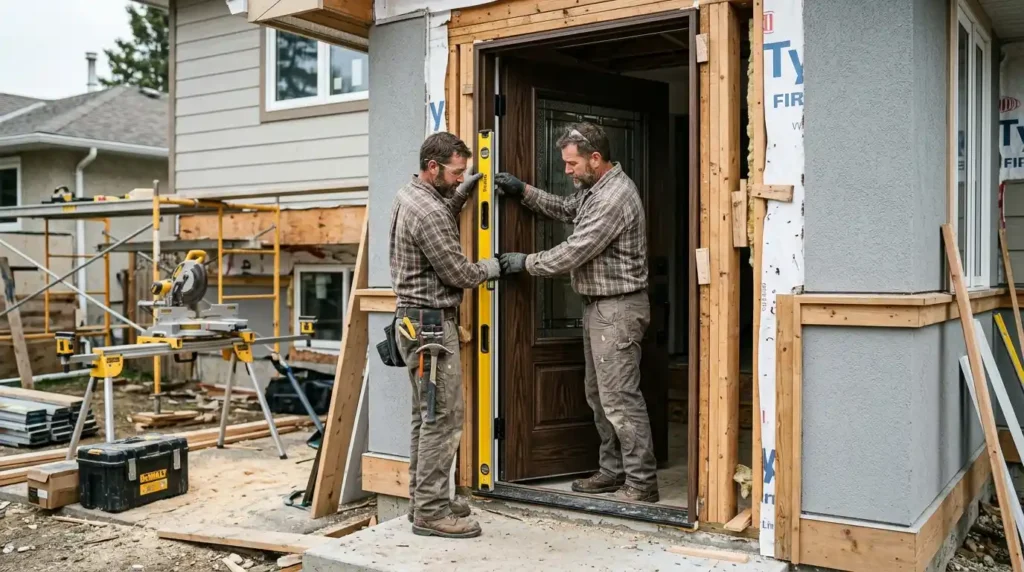
For genuine DIY door installation confidence replacing an interior door with a pre-hung unit in an existing frame the project is accessible with basic tools: drill, level, shims, pry bar, hammer, and measuring tape. DIY hardware installation saves $50 to $150, and DIY painting or staining saves $100 to $300 in labor.
Exterior doors, fire rated installations, and any project involving structural work or building code compliance should go to a licensed professional rather than a confident amateur.
Conclusion
A door is not a commodity purchase. It is a security layer, an acoustic barrier, a thermal envelope component, and the clearest visual signal your home sends about the care that’s gone into it. Whether you are selecting a front door that transforms the appearance of your home’s exterior, a pocket door that saves valuable space in a compact bathroom, or an interior door that improves bedroom privacy and sound control, the choice benefits from the same careful consideration as any major design or renovation decision. Get the mechanism right first. Then the material. Then the hardware. In that order, and the result holds for the next twenty years.
Frequently Asked Questions (FAQ’s)
Start with how the space is used and which opening mechanism works best there. After choosing the right door type, compare materials, security, insulation, maintenance, and hardware.
A pocket door is better where floor space is limited because it slides into the wall instead of swinging outward. A solid-core swing door is usually the stronger choice when privacy and sound reduction matter more.
Fiberglass generally requires less maintenance and handles moisture, warping, and harsh weather better than solid wood. Wood offers more natural warmth and character but needs proper sealing and ongoing care.
The article places typical door installation at roughly $338 to $1,488, while front door replacement can range from about $1,200 to $6,000 or more depending on material, hardware, glass, and installation complexity.
A basic pre-hung interior door can be manageable for an experienced DIYer, but exterior doors, fire-rated doors, and projects involving structural changes or building-code requirements are better handled by a licensed professional.

10 thoughts on “Door: The Most Underestimated Design and Security Decision in Any Home”